IT Service Optimization: The Need for IT Visibility

IT service optimization is the ongoing practice of improving IT performance, efficiency, and cost by managing assets, services, and configurations from a single accurate source of truth.
Most IT teams are still working from incomplete data. When asset records are stale, service dependencies are undocumented, and configuration changes go untracked, optimization efforts stall before they start. According to a 2026 Splunk report, downtime costs for Global 2000 companies surged 50% in just two years, reaching $600 billion annually, and a significant share of that exposure originates from gaps in IT visibility. Organizations that invest in accurate, discovery-sourced data consistently outperform those that do not on every operational measure that matters.
| What Is IT Visibility? IT visibility is the practice of monitoring and analyzing data across an organization’s infrastructure to produce a current, accurate picture of all assets, configurations, and service dependencies. When paired with a discovery-driven CMDB, it gives operations teams the factual foundation to reduce unplanned downtime, eliminate wasted spend, and support IT service optimization across every layer of the environment. |
What Is IT Visibility?
IT visibility is the ability to monitor and analyze data across an organization’s IT systems. It gives operations teams a full picture of how IT services are performing and surfaces issues before they escalate into outages. Beyond basic monitoring, IT visibility produces a structured understanding of IT assets, including how they are configured, how they relate to one another, and how changes to one component affect the rest.
That structural understanding is what makes IT service optimization possible. Without it, teams respond reactively rather than proactively. With it, they can anticipate capacity constraints, close security gaps, and make decisions grounded in evidence rather than assumption.
Why IT Visibility Matters for IT Service Optimization
Organizations that build IT visibility into their operational model gain advantages across five areas that directly affect service quality.
- Efficient resource allocation. IT visibility allows teams to monitor and track assets, identifying which resources are underutilized and which are over-provisioned. Reallocating those assets reduces wasted spend and ensures capacity is directed where demand is highest.
- Stronger security posture. With full visibility into their infrastructure, teams can identify vulnerabilities and configuration gaps before attackers do. For higher-risk organizations in finance and healthcare, a Forbes Technology Council analysis (April 2024) found that downtime can eclipse $5 million an hour in certain scenarios. Proactive identification of exposure points is not optional at that cost level.
- Faster, evidence-based decisions. Visibility data gives IT leaders the performance and health metrics they need to optimize workflows, identify bottlenecks, and act on real conditions rather than estimates.
- Compliance and audit readiness. Accurate tracking of software licenses, hardware inventory, and configuration documentation keeps organizations audit-ready and reduces the risk of compliance penalties.
- Risk mitigation at the source. Full asset visibility lets teams catch risks before they escalate into incidents. That shift from reactive to proactive management directly reduces service disruptions.
How IT Visibility Enables IT Service Optimization
IT visibility does not just provide data. It changes how teams operate day to day. The practical improvements show up across six operational areas.
| How IT Visibility Drives Optimization: IT visibility enables IT service optimization by closing the gap between what IT teams assume about their environment and what is actually running. Discovery-sourced asset records, live dependency maps, and configuration history give operations teams the evidence base to reduce mean time to resolve incidents, allocate capacity accurately, and assess change risk before a change window opens. |
Performance monitoring with a current baseline
When teams have access to current performance data, they can identify and resolve issues before users report them. That shortens mean time to detect (MTTD) and mean time to resolve (MTTR), two metrics that directly measure the quality of IT service delivery.
Resource management grounded in actual usage
IT visibility surfaces which assets are underutilized and which are running at capacity. With that data, teams can right-size environments, defer unnecessary purchases, and direct investment toward areas of genuine constraint.
Predictive maintenance before failures occur
Performance data analyzed over time reveals patterns that precede failures. Teams that act on those patterns schedule maintenance before disruption occurs, which extends asset life and reduces unplanned downtime.
Capacity planning based on real demand
Visibility into actual utilization rates gives IT planners the evidence they need to justify investments and upgrades. Decisions made from real data are easier to defend and less likely to result in over- or under-provisioning.
Root-cause analysis for performance issues
When incidents occur, visibility data lets teams trace the chain of causation rather than guessing at the source. Pinpointing the root cause of a performance issue enables targeted fixes, which prevents recurrence rather than just masking symptoms.
Alignment between IT performance and business goals
IT visibility gives teams the metrics they need to demonstrate that IT assets are contributing to business outcomes. Tracking KPIs tied to business objectives closes the gap between IT operations and the goals that executive leadership cares about.
How to Build IT Visibility Into Your Operations
Starting with IT visibility does not require a full platform replacement. A structured approach makes the process manageable.
- Centralized asset management. A centralized system tracks asset details, configurations, and usage data in one place. That single record eliminates the reconciliation work that comes from managing multiple disconnected inventories.
- High-frequency discovery cycles. Scheduled, high-frequency discovery scans the IT environment on a regular cadence, collecting current asset data without requiring manual surveys. Discovery data populates the Configuration Management Database (CMDB), ensuring the record of assets reflects the actual environment. Understanding how the CMDB and ITSM connect is foundational, as the CMDB serves as the authoritative data source for incident, problem, and change management workflows.
- Asset classification. Categorizing assets by criticality, ownership, and function helps teams prioritize management effort. High-criticality assets with complex dependencies warrant more frequent discovery and tighter change controls.
- Monitoring and reporting. Ongoing performance monitoring, availability tracking, and vulnerability reporting provide the continuous data feed that makes proactive management possible.
- Integration with ITSM platforms. Connecting IT visibility data to IT service management and operations processes means that incident management, problem management, and change management decisions are all made from the same factual baseline. Incomplete visibility going into a change window is one of the leading contributors to unplanned outages.
- Security and compliance controls. Visibility practices need to include regular software and firmware updates, security control enforcement, and documentation that supports compliance verification.
How Virima Delivers IT Visibility for IT Service Optimization
| How Virima Delivers IT Visibility: Virima delivers IT visibility through a unified platform that combines high-frequency IT discovery, an automated CMDB, IT asset management, ViVID™ service maps, and ITOM capabilities. Discovery data populates the CMDB automatically, giving operations teams a current, accurate record of assets, dependencies, and configurations that supports IT service optimization at every layer of the environment. |
Virima’s platform addresses the core gaps that prevent IT service optimization from delivering consistent results.
Explore how Virima builds Trusted Runtime Truth for agentic IT on the Trusted Runtime Truth page.
Full-lifecycle asset management
The Virima ITAM module manages hardware and software assets from procurement through disposal. All financial data, utilization records, and lifecycle status are maintained in a single platform, eliminating the spreadsheet-based tracking that creates blind spots in IT service optimization efforts.
High-frequency discovery and CMDB population
Virima IT Discovery scans the environment at regular intervals, collecting current asset data and populating the Virima CMDB automatically. That CMDB serves as the single source of truth for asset management, change management, and incident response. Discovery data is mapped across physical devices, virtual machines, cloud instances on AWS and Azure, and network infrastructure.
Service dependency mapping with ViVID™
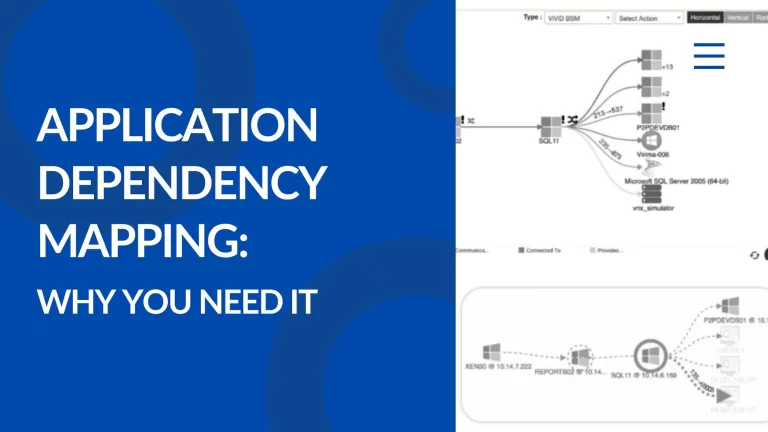
ViVID™ service maps are built from discovery data, showing how applications, servers, and infrastructure components connect and which services depend on which components. IT teams use these maps to assess blast radius before making changes and to trace the root cause of incidents back to their source. For a deeper look at the value this delivers, see the key business benefits of IT service mapping.
ITSM platform integration
Virima integrates bidirectionally with ITSM platforms including ServiceNow, Ivanti, Jira Service Management, Halo, Xurrent, Hornbill, and TeamDynamix. That integration ensures that asset records, dependency maps, and configuration data flow directly into the tools teams already use for incident, problem, and change management.
License compliance management
Virima tracks software license entitlements against actual installs, with device-level and ownership detail included. That tracking closes the compliance gap between what organizations think they are running and what is actually deployed.
IT operations management
The Virima ITOM module brings discovery, asset management, ViVID™ service maps, and CMDB together under a single operational view. For teams managing hybrid environments at scale, the ITOM layer provides the operational picture that individual tools cannot. To understand how ITOM and ITAM interact, see ITOM vs. ITAM: How to Bridge Gaps and Maximize IT Performance.
Turning IT Visibility Into a Continuous Optimization Engine
IT service optimization is not a one-time project. It is a discipline that requires accurate, current data as its foundation. Organizations that build IT visibility into their operational model, through discovery-sourced CMDB data, ViVID™ service maps, and integrated ITSM workflows, consistently deliver more reliable services, respond to incidents faster, and manage costs with greater precision.
The tools exist to make this practical. The barrier is usually not technology but the absence of a discovery-driven data layer that keeps visibility current as the environment changes.
Schedule a demo to see how Virima delivers the Trusted Runtime Truth your IT service optimization strategy requires.
Move Faster. Act Safely.
Frequently Asked Questions
What is IT visibility and why does it matter for service optimization?
IT visibility is the ability to monitor and analyze data across IT assets, configurations, and service dependencies to produce an accurate, current picture of the IT environment. It matters for IT service optimization because decisions made without accurate visibility are based on assumptions rather than evidence. Inaccurate data leads to avoidable outages, wasted spend, and failed changes.
What is the difference between IT visibility and IT monitoring?
IT monitoring tracks real-time metrics such as CPU usage, uptime, and response times, while IT visibility is broader. It covers asset inventory, configuration relationships, software licensing, service dependencies, and historical change data. Monitoring tells you what is happening right now; visibility tells you what exists, how it connects, and what will break if something changes.
How does a CMDB support IT service optimization?
A CMDB stores configuration data for every IT asset, including how assets relate to services and to each other. When it is populated by high-frequency discovery data, it becomes the authoritative source of truth for change management, incident response, and capacity planning. Teams that use a discovery-sourced CMDB make faster decisions with fewer errors because they are acting on current data rather than records that may be months out of date.
What role does service mapping play in IT service optimization?
Service mapping shows which infrastructure components support which services. With a current service map, IT teams can assess the impact of a change before executing it, trace the root cause of an incident back to its source, and plan maintenance windows with full knowledge of which services will be affected. Service dependency mapping is one of the highest-value outputs of a mature IT visibility practice.
How does Virima help organizations achieve IT service optimization?
Virima combines IT discovery, CMDB automation, IT asset management, ViVID™ service maps, and ITOM in a single platform. High-frequency discovery populates the CMDB automatically, keeping asset records current. Bidirectional ITSM integrations feed that data into the service management tools teams already use. The result is a continuous, discovery-driven visibility layer that supports proactive IT service optimization across hybrid environments.