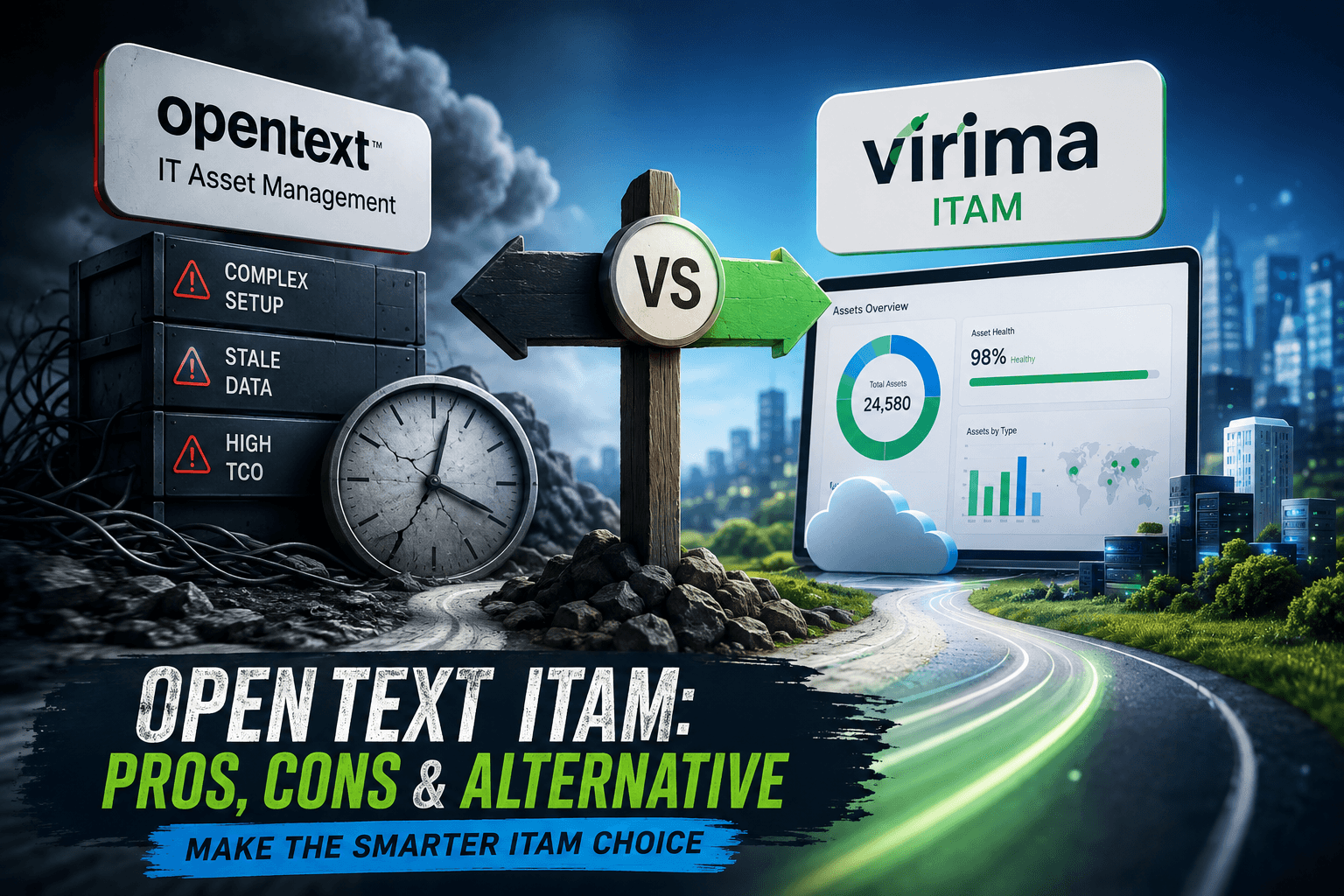
OpenText IT Asset Management: Pros, Cons, and Alternative

Your annual software audit notice arrives from a major vendor. The asset team pulls up the ITAM repository, but the hardware discovery data is two weeks old. Three software license allocations do not match active cloud instances, and nobody can confirm whether retired servers were decommissioned or merely powered down. That uncertainty turns audit preparation into a multi-week fire drill.
In enterprise environments, OpenText Universal Discovery and Asset Management remains a recognized choice for organizations managing complex IT estates. Born from HPE and Micro Focus lineage, OpenText offers broad inventory collection across legacy hardware, networks, and software licenses. However, many IT operations and asset managers hit operational limits as infrastructure scales into hybrid cloud and rapid deployment cycles.
According to the Flexera 2025 State of ITAM Report, IT teams continue to lose visibility across sprawling hybrid assets, leading to unbudgeted audit true-ups and compliance exposure. Evaluating an ITAM platform requires looking past catalog feature lists to understand daily operating overhead, reconciliation accuracy, and time-to-trust.
This article reviews the core capabilities, advantages, and operational drawbacks of OpenText IT Asset Management, and outlines why a discovery-backed solution like Virima ITAM offers a more agile alternative for multi-cloud hybrid IT estates.
What is OpenText IT Asset Management?
OpenText IT Asset Management (ITAM), part of the OpenText Asset Management and Universal Discovery family (formerly Micro Focus / HPE), tracks hardware, software, and cloud assets across their life cycle to support compliance, cost optimization, and ITSM workflows.
What OpenText IT Asset Management is built to deliver
OpenText IT Asset Management focuses on unifying asset tracking across physical infrastructure, software entitlements, and network resources. Designed for large-scale enterprise deployments, the platform aims to bridge asset governance with broader IT service management workflows.
Core evaluation areas typically center on how well an ITAM suite maintains accurate asset state across three distinct operational layers:
- Hardware asset management: Tracking physical devices, servers, network gear, and endpoints from procurement through disposal.
- Software asset management (SAM): Reconciling software license entitlements against active installations to prevent compliance fines.
- Cloud and hybrid asset discovery: Inventorying virtual machines and cloud instances across AWS and Azure multi-cloud environments.
Pros of OpenText IT Asset Management
OpenText brings enterprise heritage and specialized capabilities that appeal to large organizations with mature ITIL frameworks:
- Extensive network and device discovery: Inherited from Micro Focus uCMDB and Universal Discovery, OpenText provides deep Layer 2/3 network discovery across diverse network hardware, switches, firewalls, and storage gear.
- Large software recognition library: Strong software title recognition helps enterprise teams map installed software to complex enterprise license entitlements.
- Vendor-neutral ITSM integration: Capable of pushing asset inventory into third-party ITSM platforms including ServiceNow, BMC, and Jira Service Management.
- Multi-method inventory collection: Supports agentless, agent-based, and probe-driven discovery across on-premises and cloud resources.
Cons and production challenges with OpenText ITAM
While OpenText offers deep inventory depth, enterprise IT teams often hit operational friction once the platform is in production.
Specialist administrator dependency and high upkeep load
Universal Discovery and Asset Management environments require specialized expertise to configure probes, maintain content packs, and write custom reconciliation rules. When only a small group of certified administrators can manage the platform, discovery job backlogs build up and asset records quickly become stale.
Reconciliation lag in dynamic multi-cloud environments
Fast-changing cloud workloads, microservices, and remote endpoints challenge traditional inventory architectures. When asset updates lag deployment speed, change risk increases and financial asset tracking fails to reflect actual usage.
Total cost of ownership (TCO) complexity
Beyond base licensing, OpenText ITAM carries ongoing costs for specialized content updates, professional services, and dedicated administrative headcount. For mid-market and lean enterprise IT teams, this total cost often outweighs the operational benefit.
The trust gap between inventory and operational action
A populated database is not the same as actionable asset intelligence. Research from the EMA ServiceOps 2025 Report shows that inaccurate CMDB and asset data directly delays incident resolution and change approval. Visibility gaps across multi-environment assets also slow containment when security and operations teams cannot confirm what is live, owned, and connected.
Comparing OpenText ITAM with Virima
For IT leaders evaluating alternatives, architecture, administrative load, and time-to-value define the shortlist.
| Evaluation Criteria | OpenText ITAM | Virima ITAM |
|---|---|---|
| Discovery architecture | Probe-heavy agentless and agent-based collection requiring specialist pack tuning | Automated agentless and agent-based high-frequency discovery cycles across hybrid IT |
| Network and device depth | Strong L2/L3 heritage across diverse network hardware | Broad hybrid inventory with service context after definitions are provided |
| Administrative overhead | High; often needs dedicated Universal Discovery / ITAM specialists | Leaner operating model; operable by generalist IT operations and asset teams |
| Service dependency mapping | Modeling-heavy service definition workflows | ViVID™ service maps built automatically once service inputs are defined |
| ITSM coexistence | Custom connectors for platforms such as ServiceNow and Jira | Bi-directional sync across enterprise ITSM platforms, including ServiceNow, Jira Service Management, Ivanti, HaloITSM, Xurrent, and Hornbill |
| Time to usable inventory | Often multi-quarter for full probe, pack, and reconciliation setup | Scoped pilots commonly produce usable asset views within weeks, depending on environment complexity |
What is the best OpenText IT Asset Management alternative?
Virima is a strong OpenText ITAM alternative when teams need high-frequency hybrid discovery, ViVID™ service maps after service definitions are set, and bi-directional ITSM sync without specialist Universal Discovery pack upkeep. OpenText remains a fit when deep L2/L3 network discovery matters and Universal Discovery specialists are already staffed.
| See how discovery-sourced inventory becomes Trusted Runtime Truth your ITAM and ITSM teams can act on. Explore Trusted Runtime Truth. |
Why choose Virima as an OpenText ITAM alternative?
Virima combines high-frequency hybrid asset discovery, ViVID™ service mapping after service definitions are provided, and open bi-directional ITSM integrations without the specialist maintenance load common in Universal Discovery environments. Teams keep their existing ITSM while improving freshness and dependency context.
Why Virima is a strong option for hybrid ITAM
Virima combines authoritative asset discovery with CMDB and service mapping capabilities, without the administrative friction of legacy suites.
- Customer-reported operational outcomes: In active customer deployments, teams have reported faster incident resolution, stronger SLA adherence, and fewer change-related outages. Treat these as directional outcomes, not guaranteed results.
- Discovery-backed accuracy: High-frequency discovery cycles automatically populate hardware, software, cloud (AWS and Azure), and network asset state.
- Dynamic service context with ViVID™: Connects IT assets to the applications they support once service definitions are provided, showing dependency paths for risk and change. Learn more about Virima Service Mapping capabilities.
- ITSM platform integration: Bi-directionally syncs with ServiceNow, Jira Service Management, Ivanti, HaloITSM, Xurrent, and Hornbill, keeping your primary ITSM system populated with trusted asset data.
- Leaner day-two operations: Generalist IT teams can maintain accurate asset records without relying only on scarce platform specialists. Business Pro packages full discovery-backed ITAM, CMDB, and maps for growing hybrid estates.
When OpenText still fits, and when to transition
Not every OpenText estate should rip and replace on day one. Match the path to risk and staffing reality.
Choose OpenText / stay on Universal Discovery if:
- Your organization already staffs Universal Discovery specialists and the probe and content-pack model is stable.
- Deep L2/L3 network and device discovery is the primary requirement, and hybrid cloud drift is secondary.
- You are standardized on OpenText service management and want inventory to stay inside that stack.
Augment OpenText with Virima if:
- You need fresher hybrid inventory and service context while keeping existing OpenText or third-party ITSM workflows.
- Audit and change windows expose stale last-seen dates, but a full platform swap is not approved yet.
Transition to Virima as the ITAM and discovery foundation if:
- Specialist admin load, pack upkeep, and multi-quarter reconciliation cycles dominate TCO.
- You need ViVID™ service maps after service definitions are set, plus bi-directional ITSM sync without another suite lock-in.
- You want the full discovery-sourced ITAM, CMDB, and maps stack packaged for growing hybrid estates through Business Pro.
When evaluating your ITAM roadmap, still complete these practical checks:
- Audit current administrative costs: Calculate the full TCO of maintaining probes, custom packs, and specialist administration.
- Measure data freshness: Check the average last-seen date across hardware and software assets during active change windows.
- Pilot dynamic discovery: Test Virima in a production-like network segment to benchmark time-to-value, reconciliation speed, and service map accuracy.
See how high-frequency discovery and ViVID™ service maps give ITAM teams audit-ready hybrid inventory without Universal Discovery specialist overhead. Explore Business Pro at https://virima.com/business-pro for how Virima packages that path.
Frequently asked questions
What is the difference between ITAM and CMDB?
ITAM focuses on the financial, contractual, and physical life cycle of IT assets (procurement, licensing, warranty, disposal). A CMDB focuses on configuration items (CIs) and their operational relationships to support IT service delivery, change management, and incident response.
Why do enterprise ITAM implementations encounter delays?
Implementations often stall due to overly complex discovery probe configurations, custom reconciliation rules, and reliance on dedicated tool specialists. Automated discovery engines and generalist-friendly workflows accelerate time-to-value when the estate does not require deep specialist pack maintenance.
When should teams keep OpenText Universal Discovery?
Keep OpenText when deep L2/L3 network discovery is the primary need, Universal Discovery specialists are already staffed, and the stack is standardized on OpenText service management.
Can Virima ITAM integrate with existing ITSM tools?
Yes. Virima provides bi-directional synchronization with leading ITSM platforms including ServiceNow, Jira Service Management, Ivanti, HaloITSM, Xurrent, and Hornbill, so asset data can stay accurate across the stack you already run.
How does Virima handle software asset management (SAM)?
Virima discovers installed software across on-premises servers, cloud instances, and endpoints, reconciling installations against license entitlements to identify compliance risks and optimization opportunities.