Linux CMDB Discovery: Disk Capacity, Last Login, Process Data, and Non-Sudo Scanning

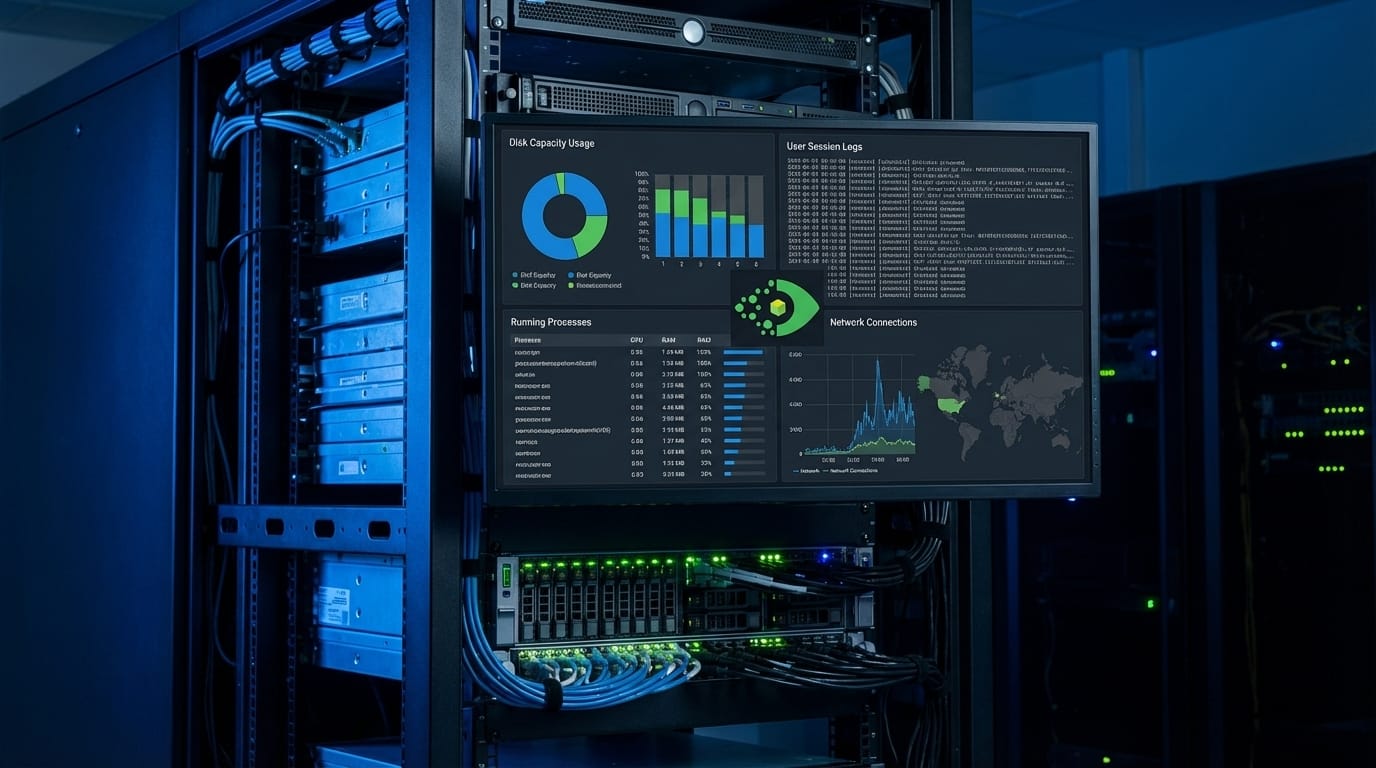
Linux is the operating system for enterprise servers, containerized workloads, and developer workstations — but it presents a specific discovery challenge: most production Linux environments have strict sudo policies that block the elevated commands discovery tools typically require. The result is discovery that either fails silently or returns incomplete data. The fix combines a non-sudo fallback strategy (collecting what is available without elevated access), agent-based discovery where SSH is unavailable, and simpler agent deployment directly from the management application. Virima 6.1.1 adds disk capacity (total/used/free), last logged-in user and time, IP connections, listening processes, and installed package data to Linux discovery — with non-sudo fallback logic for locked-down environments.
Linux in the enterprise: broader than “just servers”
Linux runs more enterprise workloads than any other operating system. Its footprint spans:
- Web and application servers — NGINX, Apache, Tomcat, Node.js stacks on Red Hat, CentOS, Ubuntu, and Debian
- Database servers — PostgreSQL, MySQL, MariaDB, and MongoDB typically run on Linux
- Containerized infrastructure — Kubernetes nodes and container hosts run Linux regardless of the container images they serve
- Developer workstations — engineers at software companies increasingly run Ubuntu or Fedora on physical workstations or in virtual machines
- IoT and edge computing — embedded Linux (Raspberry Pi OS, Yocto, Buildroot) runs on edge devices and industrial controllers
Each Linux instance that matters to a business service belongs in the CMDB — with accurate data, not a skeleton record.
What CMDB needs from Linux discovery
A complete Linux CI in the CMDB contains more than hostname and IP address. These are the data categories that make Linux CIs operationally useful:
Disk capacity
Total capacity, used space, and free space per mounted filesystem. The df -h command provides this data without elevated access on most Linux distributions. Disk capacity data in the CMDB enables:
- Storage capacity planning — identify servers approaching full disks before they cause outages
- Decommission validation — confirm a server’s storage is not in use before shutdown
- Change planning — verify available disk space before patching or software installation
A common CMDB gap: disk data is present at discovery time but never updated. Disk usage changes daily on active servers. Discovery schedules for Linux production servers should run at least weekly to keep disk data current.
Last logged-in user and time
The last command on Linux outputs a log of user login and logout events. CMDB discovery should capture:
- Last user who logged in — username of the most recent interactive session
- Last login timestamp — date and time of that session
- Last login source IP — where the session originated (useful for access review)
This data answers: “Is anyone actively using this server?” A Linux server with no interactive login in 90 days is a decommission candidate. A Linux server with an unexpected login from an unfamiliar IP is a security incident indicator.
IP connections
Active and established network connections from netstat -an or ss -an output show which external hosts the server is communicating with at discovery time. This data matters for:
- Service dependency discovery — which other servers does this server connect to?
- Security anomaly detection — are there outbound connections to unexpected IP ranges?
- Network segmentation validation — is this server communicating outside its expected network zone?
Listening processes
The combination of ss -tlnp or netstat -tlnp (which requires sudo on many distributions) with ps aux identifies which processes are listening on which ports. This data is the foundation for:
- Application discovery — linking listening processes to Application CIs in the CMDB
- Service mapping — understanding which processes must be running for a service to function
- Change impact analysis — which applications restart or fail if this server reboots?
Installed packages
Package manager inventory — from rpm -qa (Red Hat/CentOS/RHEL) or dpkg -l (Debian/Ubuntu) — lists every installed package with name, version, and architecture. This data drives:
- Software license compliance — count licensed software instances across all Linux servers
- Vulnerability management — match installed package versions against CVE databases
- Configuration drift detection — identify servers where package versions deviate from the standard build
The sudo problem: why discovery fails in locked-down environments
Sudo (superuser do) is the Linux mechanism for running commands with elevated privileges. Some discovery commands require sudo: netstat -tlnp (to see process-to-port mappings), fdisk -l (for disk partition details), and others.
In production Linux environments — especially those with CIS benchmark hardening, PCI-DSS compliance requirements, or security team policy — sudo access for service accounts is restricted or prohibited. The discovery service account may have SSH access but no sudo rights.
What happens when discovery requires sudo but the account lacks it:
- The SSH session opens successfully
- The discovery tool runs its command sequence
- Commands requiring sudo fail with a permissions error
- The discovery tool either aborts the CI creation or creates a partial CI with only the non-elevated data populated
- The IT team sees a CI with hostname and IP but no disk data, no process data, and no package inventory — and often does not know why
This is a silent failure mode. The CMDB shows a CI exists. It looks complete at first glance. Only on inspection does it become clear that half the data is missing. And because the tool did not surface a clear error, the team does not know the CI is incomplete.
Non-sudo fallback logic: discovering without elevation
The solution is not to require organizations to loosen their sudo policies — it is to build discovery logic that adapts to what the service account can actually do.
Non-sudo fallback logic works in two passes:
- Pass 1 — Attempt privileged commands: Run the full discovery sequence including commands that may require sudo. Where the account has sudo rights (or where the command does not require elevation), collect all data.
- Pass 2 — Fallback for failed commands: For any command that fails due to permissions, substitute non-privileged alternatives where they exist:
| Privileged command | Non-sudo alternative |
| netstat -tlnp (process-to-port) | ss -tlnp (often works without sudo on modern kernels) or partial port list from /proc/net/tcp |
| fdisk -l (disk partitions) | df -h (filesystem usage, no elevation needed) |
| lsblk with full device details | lsblk with read-only output (usually no sudo needed) |
| rpm -qa –queryformat (full package metadata) | rpm -qa (package names and versions, no sudo) |
| /var/log/auth.log reading | last command output (no sudo needed on most systems) |
What non-sudo fallback produces:
A CI with complete data wherever non-elevated collection works, and partial data with explicit flags where sudo was required but unavailable. The IT team sees which data is complete and which is absent — a transparent, actionable result rather than a silently incomplete record.
Virima 6.1.1 implements non-sudo fallback logic for Linux discovery, collecting disk capacity (df), last login (last), IP connections (ss), and package inventory (rpm -qa / dpkg -l) without requiring elevated access — and flagging where elevated data was unavailable rather than silently omitting it.
Agent-based vs. SSH-based Linux discovery
SSH-based (agentless) discovery is the most common approach for Linux because it requires no software installation on the target — only an SSH service and a valid service account. For most environments with standard SSH access, agentless discovery is the right starting point.
However, SSH-based discovery has limits:
| Scenario | SSH-based | Agent-based |
| Servers in network segments without SSH access from discovery scanner | Does not work | Works (agent calls out to platform) |
| Servers with dynamic IPs or no consistent hostname | May fail to re-discover | Works (agent registers its own identity) |
| Servers behind strict firewalls | May fail | Works (agent initiates outbound connection) |
| Air-gapped or isolated environments | Does not work | Works with local relay |
| Very high-frequency discovery (multiple times per day) | High SSH connection overhead | Lower overhead (agent caches and pushes) |
| Environments where SSH service accounts are not permitted | Does not work | Works (agent runs as local service account) |
The practical guidance: use SSH discovery for the majority of Linux servers in accessible network segments, and deploy the Linux agent specifically for servers where SSH discovery cannot reach or where security policy prohibits SSH service accounts.
Linux agent installation from the application
Agent-based Linux discovery has historically carried a deployment overhead: generate an agent package, distribute it to target servers via an MDM or configuration management tool (Ansible, Puppet, Chef), install the agent, configure it, and validate connectivity. For large Linux fleets, this is a multi-step process that requires coordination between the discovery platform team and the systems team.
Virima 6.1.1 simplifies this by enabling Linux agent installation directly from the Virima application interface, removing the need to handle agent packages or distribution scripts manually. The workflow:
- Target Linux servers are identified by IP range or hostname in the Virima UI
- The agent installation is initiated from the application (using existing SSH credentials for the initial push)
- The agent installs, registers with the Virima platform, and begins discovery
- The CMDB populates with the agent-based CI data
This approach reduces agent deployment from a multi-day coordination task to a point-and-click operation within the discovery platform. For organizations adopting agent-based Linux discovery for the first time, or extending coverage to new network segments, the simplified deployment removes the primary operational friction point.
OS detection improvements and domain name accuracy
Two additional Linux discovery improvements in Virima 6.1.1 affect CI quality across the Linux estate:
OS detection accuracy: Earlier discovery runs sometimes misclassified Linux distributions — identifying a CentOS 8 server as “Linux” without the distribution or version detail. Improved OS detection reads /etc/os-release (the standardized OS identification file present linux agent discovery on all modern Linux distributions) and populates the CI with:
- Distribution name (Red Hat Enterprise Linux, Ubuntu, Debian, CentOS, Fedora, SUSE, etc.)
- Version (major.minor, e.g., RHEL 9.3, Ubuntu 22.04 LTS)
- Kernel version from uname -r
Accurate OS version data is the foundation for CVE matching in vulnerability management — a CI that shows “Linux” without version data is useless for vulnerability tracking.
Domain name accuracy: Linux hostname discovery sometimes returned the short hostname without the fully qualified domain name (FQDN), creating CI naming conflicts when multiple environments (dev/staging/prod) have servers with the same short hostname. Improved domain name capture reads from /etc/hostname, hostname –fqdn, and /etc/resolv.conf search domains to produce an accurate FQDN for every Linux CI.
Closing the Linux CI data gap in locked-down environments
Linux CMDB discovery is not a solved problem in most enterprise environments. Sudo restrictions create partial data. SSH-inaccessible segments create gaps. Generic OS classification produces CIs without actionable version data. Hostname normalization issues create naming conflicts.
The approach that works: non-sudo fallback logic for environments with restricted service accounts, agent-based discovery for segments where SSH is unavailable, simplified agent non-sudo linux discovery deployment from the management application, and dedicated Linux discovery that collects disk capacity, last login, IP connections, listening processes, and installed packages as standard data.
Virima 6.1.1 addresses each of these points — delivering richer Linux CI data, more resilient discovery in locked-down environments, and a simpler path to agent-based coverage where it is needed.
Ready to see what complete Linux server discovery looks like? Schedule a demo at virima.com to explore Linux discovery capabilities with the Virima team.