
ITAM for Oil and Gas Starts Where the Maintenance System Stops

 Summarize with ChatGPT
 Summarize with Claude
On November 17, 2026, Equinor detected a cyberattack against certain IT systems. In its November 20 update, Equinor said the attack had stopped, and production remained normal. For other operators, ITAM for oil and gas supports the search for devices and owners during an incident. Equinor’s update did not describe its asset records.
IT asset management (ITAM) brings together information for support and lifecycle decisions. A maintenance record may describe a compressor’s service history in detail. The gateway beside it, its connected server, and the engineer’s laptop need ownership and support information too.
What Is ITAM for Oil and Gas, and Where Does It Stop?
ITAM for oil and gas tracks technology assets and their obligations across their useful lives. The scope can include rugged laptops, servers, network equipment, field gateways, and engineering software licenses. Contracts, warranties, locations, and assigned owners add information needed for purchasing and support decisions.
ISO/IEC 19770-1:2017 specifies requirements for an IT asset management system. ISO confirmed the standard in 2024, and its scope can cover different types of IT assets. Organizations still define which assets and responsibilities belong in their own programs.
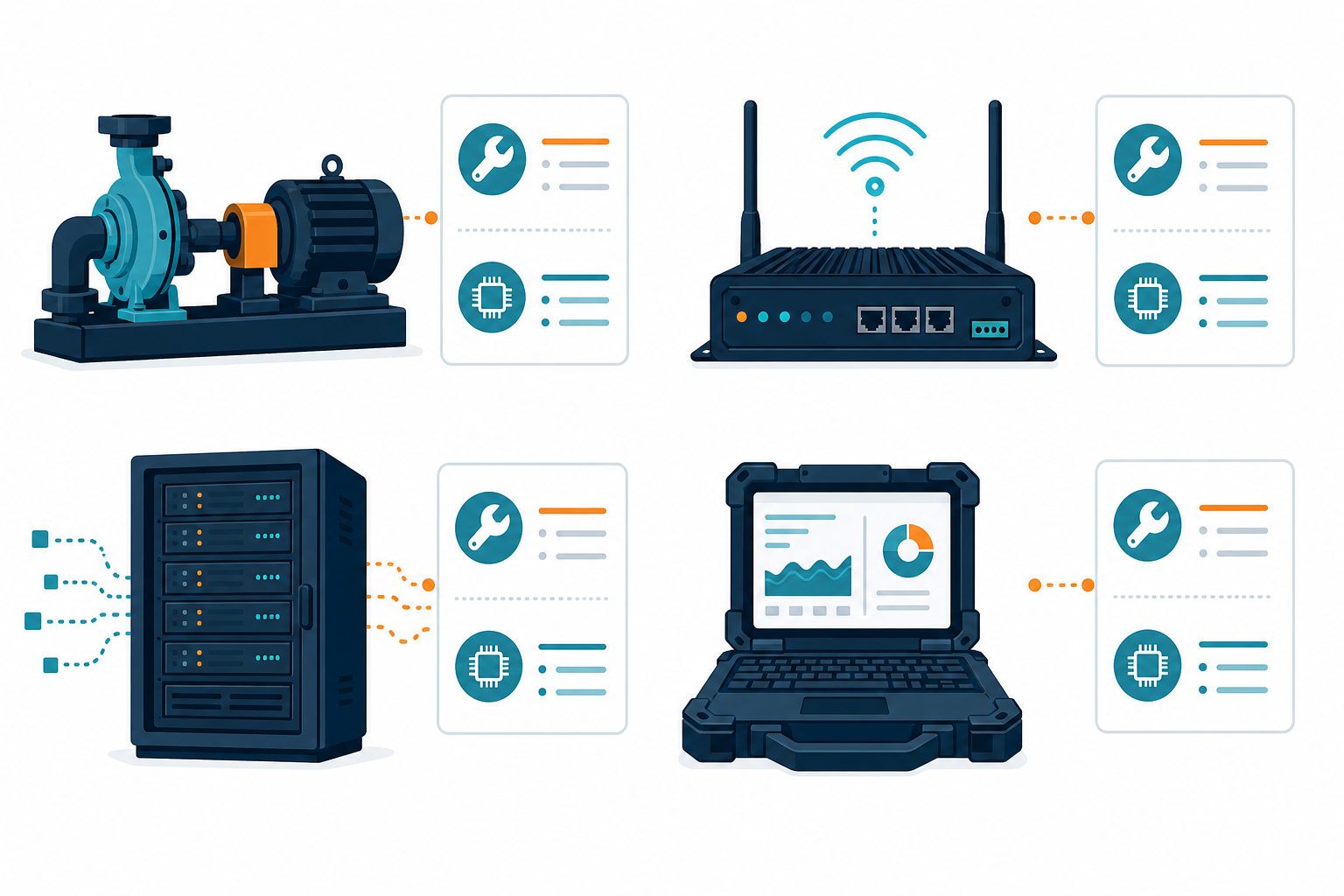
Maintenance teams typically use enterprise asset management (EAM) or computerized maintenance management systems (CMMS) for physical equipment. IBM describes Maximo’s oil and gas scope as including rigs, wells, pipelines, pumps, and plants. Technology connected to that equipment may need an IT record as well.
Which system owns which asset?
| Asset class | Typical record owner | IT asset information to consider |
|---|---|---|
| Pump, compressor, or pipeline segment | Maintenance or engineering team | Maintain equipment history in the assigned maintenance system. |
| Remote terminal unit or programmable controller | Operational technology or engineering team | Record ownership and network-visible attributes where collection is approved and supported. |
| Wellsite or platform gateway | Field IT or a designated support team | Identify the owner, support date, and known dependencies. |
| Historian or supervisory control server | Operations and IT teams | Record the operating system, support dates, and change contacts. |
| Rugged laptop or field tablet | IT or a site administrator | Track assignment, warranty, and disposal evidence. |
| Engineering software | Software asset or procurement team | Compare entitlements with available installation evidence. |
Ownership and systems of record depend on the operator’s policies. When teams share a server record, agree which team maintains each attribute.
Why Harsh, Distributed Estates Strain IT Asset Records
A device’s recorded location can lag behind a physical move. Its purchase record may sit with procurement, while a contractor holds it at a remote site. Those gaps affect the next support or ownership decision.
Flexera’s 2026 ITAM survey summary reports that 36% of respondents had complete visibility into IT assets and their business impact. Another 62% reported partial visibility. These results span industries and do not measure oil and gas operators separately.
Four places site records can fall behind
Harsh operating conditions: Heat, dust, vibration, and salt air can affect field equipment. After replacing a damaged device, the field team should report its serial number and installation date.
Contractor and partner equipment: A contractor may bring devices under its own agreement. Record the responsible organization and contract end date after the parties confirm custody.
Infrequent site access: Limited connectivity or restricted access can delay a scan. Record the last successful observation and ask the site team to confirm custody.
Changes in ownership: A divestiture can change who supports devices at a site. The seller and buyer should agree which records, contracts, and licenses transfer.
For reachable, supported systems, scheduled IT asset discovery can provide observations for comparison with site records. The collection scope, credentials, and schedule need approval from the relevant site owner. Discovery can identify technical attributes, while people confirm custody and contractual obligations.
How should a site track equipment waiting for access?
A field device waiting for an approved site visit needs an assigned reviewer and a follow-up date. The reviewer can request shipping records or confirmation from the local team. Record the evidence used for an interim decision, especially when a support contract is near expiration.
What Stale IT Asset Records Cost Across the Business
Operations leaders need service context
During an incident, responders may need to identify devices associated with an affected application. An outdated owner or missing relationship can send a question to the wrong team.
Field support needs dependable assignments
Before a visit, field support may compare purchase orders, site lists, and support records. Measure reconciliation time locally rather than assuming a fixed saving.
Procurement needs evidence for software audits
Flexera also reports that 48% of surveyed organizations had been audited in the preceding year. The cross-industry survey does not establish an oil and gas audit rate. Procurement can compare known installations with license terms before renewal. Agreements may use device, user, processor, or concurrent-use measures, so installation counts alone cannot establish compliance.
What if a device has no operator purchase order?
A field device without an operator purchase order may belong to a contractor, partner, or previous site owner. The site lead should confirm custody before changing the record. Procurement can identify the applicable agreement and determine who is responsible for support, transfer, or return.
How ITAM for Oil and Gas Covers Each Lifecycle Stage
Discovery adds observations to the record
Scheduled discovery cycles can identify supported network-connected infrastructure and installed software. Agent-based, agentless, and application programming interface (API) methods cover different technologies and access conditions. Approved credentials, network reach, and supported protocols determine what a particular scan can observe.
The site team can compare results with its existing list. Staff should investigate unmatched or missing devices before changing their status.
Trusted Runtime Truth connects discovery-sourced records with ownership, relationships, changes, and potential service impact. The information reflects the sources and scheduled discovery cycles available to the organization.
Owners maintain lifecycle and contract details
An asset record can hold a lifecycle status, support dates, and an assigned owner. For oil and gas sites, consider site type, owning entity, and contract end date. The owning entity might be the operator, contractor, or joint-venture partner.
People must confirm contractual ownership and disposal approval. Record the source and confirmation date when a site owner resolves those questions.
Teams check dependencies before retirement
Before a gateway moves or retires, its owner should review connected applications and infrastructure. A configuration management database (CMDB) can hold those relationships alongside the asset record. The change owner decides whether the evidence is sufficient and records the reason for retirement.
For data-bearing equipment, the security owner should select an appropriate sanitization method. The NIST media sanitization guidelines relate sanitization controls to information sensitivity. The disposal record should retain the approval and evidence required by the organization’s policy.
| Task | Site-list approach | Record supported by discovery |
|---|---|---|
| Find devices | Compare local lists and recent site reports. | Compare approved scan results with the existing inventory. |
| Confirm ownership | Ask teams to identify the responsible party. | Store the confirmed owner on the asset record. |
| Review support dates | Search contracts and calendar reminders. | Keep verified warranty and support dates with the asset. |
| Check dependencies | Ask service owners for known connections. | Review recorded relationships and validate important gaps. |

ITAM for Oil and Gas Examples From Wellsite to Head Office
The following examples illustrate decisions an operator could make. They do not describe a named customer’s deployment.
Wellsite gateway retirement: A field IT lead proposes retiring an unsupported gateway. A recorded and validated relationship shows that a historian feed still uses it. The change owner arranges a replacement and records the retirement approver and reason.
Contractor demobilization: A drilling contractor is leaving a site. The site lead checks devices assigned to that contractor and confirms whether each one is returned or transferred. The support team updates ownership and access records after the parties agree.
Divestiture handoff: A site is being sold to another operator. The seller’s IT lead prepares an agreed export of site devices and their support details. Both parties review which software rights and contracts can transfer before completing the handoff.
Rugged laptop disposal: A field laptop reaches its approved replacement date. The asset owner records the disposal decision and its reason. Security selects the sanitization method based on the information held on the device.
Virima Supports IT Asset Visibility Across Sites
Virima complements maintenance, supervisory control, and historian systems. Scheduled discovery provides observations for supported infrastructure, and the CMDB holds configuration records and relationships. Its service management integrations can make asset information available in existing workflows, subject to configuration.
Start with one approved site
An IT manager can configure a scheduled discovery cycle for an agreed site scope. The resulting observations can be compared with the local inventory. Staff can investigate unmatched devices and add confirmed owners or support dates where those details are missing.
Discovery coverage depends on access and compatibility. Operational technology (OT) owners should approve the method, timing, and network scope before collection begins. Some equipment may require an existing engineering record or another approved source.
Review changes in the record
Later scheduled cycles provide new observations for comparison with stored records. A discrepancy gives the assigned team a reason to investigate. A site move, changed software installation, or missing device still requires confirmation from the appropriate owner.
Virima’s scheduled discovery can provide hardware and installed software information for supported systems. Teams can compare those observations with their own purchasing, contract, and entitlement records. Procurement and software owners remain responsible for interpreting license terms and renewal decisions.
The CMDB can show recorded relationships for supported infrastructure. Service maps depend on service definitions supplied by the organization. A reviewer should validate important dependencies before approving a change or retirement.
Connect existing service workflows
Virima works with service management platforms including ServiceNow, Jira Service Management, and Ivanti. Asset and configuration information can support teams handling incidents and changes through those workflows. Integration capabilities depend on the connected platform and its configuration.
Who confirms ownership of an observed field device?
A site owner or designated asset manager confirms ownership of an observed field device. Discovery can provide technical observations, while contracts and custody records establish the responsible party. The reviewer should record the confirmation date and assign unresolved ownership questions for follow-up.
Moving From Site Spreadsheets to One Lifecycle Record
An operator can begin with one site type and a defined set of technology assets. The first review should compare records that local teams already use with the available discovery results. Keep exceptions visible until someone confirms their outcome.
| Current approach | Change to test |
|---|---|
| Separate site lists with different update dates. | Compare approved discovery observations against a shared asset record. |
| Retirement decisions held in email threads. | Record the named decision-maker, reason, and required disposal evidence. |
Support incident and audit decisions
An assigned owner gives responders a contact when they investigate a device. Verified contracts and support dates also give procurement evidence to review before renewal. Measure the time spent finding records before claiming an improvement.
Make site transfers easier to verify
For contractor exits or divestitures, agree which equipment and records will change hands. The responsible teams can check ownership, licenses, and support arrangements before the transfer closes. Keep unresolved items assigned to a named person.
Begin with five practical steps
- Choose one site type and identify its asset and operations owners.
- Agree on an approved collection scope and schedule a discovery cycle.
- Compare observed devices with the current site and purchasing lists.
- Assign owners to exceptions and confirm available support dates.
- Name the retirement approver and record each decision’s reason.
Review One Site Before You Review Them All
Select a field office or midstream station and bring its current asset list to the review. Compare the list with approved discovery observations, then assign the differences to local owners. Include a retirement decision and its supporting evidence in the discussion.
Request a discovery and CMDB demo to see how Virima can support IT asset visibility across your oil and gas sites.
Frequently Asked Questions
What is ITAM for oil and gas?
IT asset management tracks devices, software, licenses, and support information across oil and gas locations. It gives teams a way to assign ownership and document lifecycle decisions for technology used at sites and offices.
Why is ITAM important for oil and gas operators?
Remote locations, contractor equipment, and ownership changes can make asset records harder to maintain. Confirmed owners, support dates, and known relationships help teams prepare for site work, audits, and equipment transfers.
What are examples of ITAM for oil and gas?
Examples include checking gateway dependencies before retirement, confirming contractor equipment at demobilization, and transferring asset records during a divestiture. Teams also document approval and sanitization when disposing of data-bearing laptops.
Does Virima replace Maximo or other maintenance systems?
Virima complements maintenance, supervisory control, and historian systems. Its scheduled discovery and CMDB can provide information about supported IT infrastructure and recorded relationships. Maintenance teams retain their physical equipment records.
Can Virima discover devices at remote oil and gas sites?
Virima uses scheduled discovery methods for supported, reachable systems. Coverage depends on network access, credentials, compatible technologies, and site approval. Some operational technology records may need an alternative approved source.