
IT Asset Visibility for Texas State Agencies in Austin Starts With One Inventory, Not Five Reports

 Summarize with ChatGPT
 Summarize with Claude
Key Takeaways
- IT asset visibility for Texas state agencies in Austin can connect server, application, vendor, and ownership records for reporting.
- Texas agencies enter IRDR responses in SPECTRIM, while discovery and agency-supplied records can support their preparation.
- Agency information resources managers need confirmed owners and review dates for shared, vendor-run, and agency-operated systems.
A vendor-run system can hold information for millions of Texans. IT asset visibility for Texas state agencies in Austin starts with identifying that system, its agency owner, and the vendor responsible for operating it.
On May 13, 2026, Texas Cyber Command detected an incident involving the Texas Parks and Wildlife Department’s license-system vendor. The department’s incident notice says an unauthorized actor may have obtained information for more than three million hunting and fishing license customers.
The potentially exposed information included driver’s license details, passport numbers if provided, contact information, and residential addresses. The department said Social Security numbers, dates of birth, and financial information were not obtained. It also said it was working with the vendor on additional safeguards.
The notice does not identify an inventory or CMDB failure. The incident does, however, illustrate why an agency needs a clear record of systems operated on its behalf. That record should identify the agency contact, the vendor, the relevant contract, and the services supported.
Those same facts can help staff prepare for state reporting. They remain useful only when the people responsible for them confirm and maintain them.
What Texas State Agencies Are Asked to Inventory, and by Whom
The Texas Department of Information Resources (DIR) collects information about state agencies’ technology infrastructure. Texas Government Code Section 2054.068 includes servers, mainframes, cloud services, artificial intelligence systems, and vendors that operate agency infrastructure.
DIR also conducts the Information Resources Deployment Review (IRDR). Its 2026 IRDR guidance says agencies provide an inventory of technology assets and applications, including artificial intelligence systems. The 2026 submission deadline was March 31.
Information Resources Managers (IRMs) coordinate the review. Agency staff enter and confirm the required information in the Statewide Portal for Enterprise Cybersecurity Threat, Risk, and Incident Management, known as SPECTRIM.
| Reporting activity | State organization | Inventory or evidence involved | 2026 timing |
|---|---|---|---|
| Information Resources Deployment Review | DIR | Agency devices, applications, and AI inventory. | Agency responses were due March 31. |
| Infrastructure risk assessment | DIR, with Texas Cyber Command consultation on security. | IRDR responses, server inventory, AI inventory, and security information. | DIR issued its assessment methodology in September. |
| Information security plan | Texas Cyber Command. | Agency security objectives and related assessments. | Agency plans were due June 1. |
| Cybersecurity and legacy project prioritization | DIR and Texas Cyber Command. | Proposed projects and their associated applications. | The state report was due October 1. |
House Bill 150 established Texas Cyber Command and transferred cybersecurity functions from DIR. DIR retained its infrastructure reporting responsibilities. The SPECTRIM program overview distinguishes functions managed by Texas Cyber Command from reporting programs managed by DIR.
The reporting deadlines serve different purposes. An agency should check current instructions and applicability before using an inventory to prepare a submission.
Who manages Texas agency reporting in SPECTRIM?
Texas Cyber Command manages cybersecurity functions in SPECTRIM, while the Department of Information Resources manages separate reporting programs there. Access and available functions depend on the organization and program. Agency staff should follow the current instructions for each submission rather than assuming one office receives every report.
Where Texas State Agency IT Asset Inventories Split Apart
An agency can be accountable for a service without operating every component itself. A useful inventory separates operational responsibility from contractual and reporting responsibility.
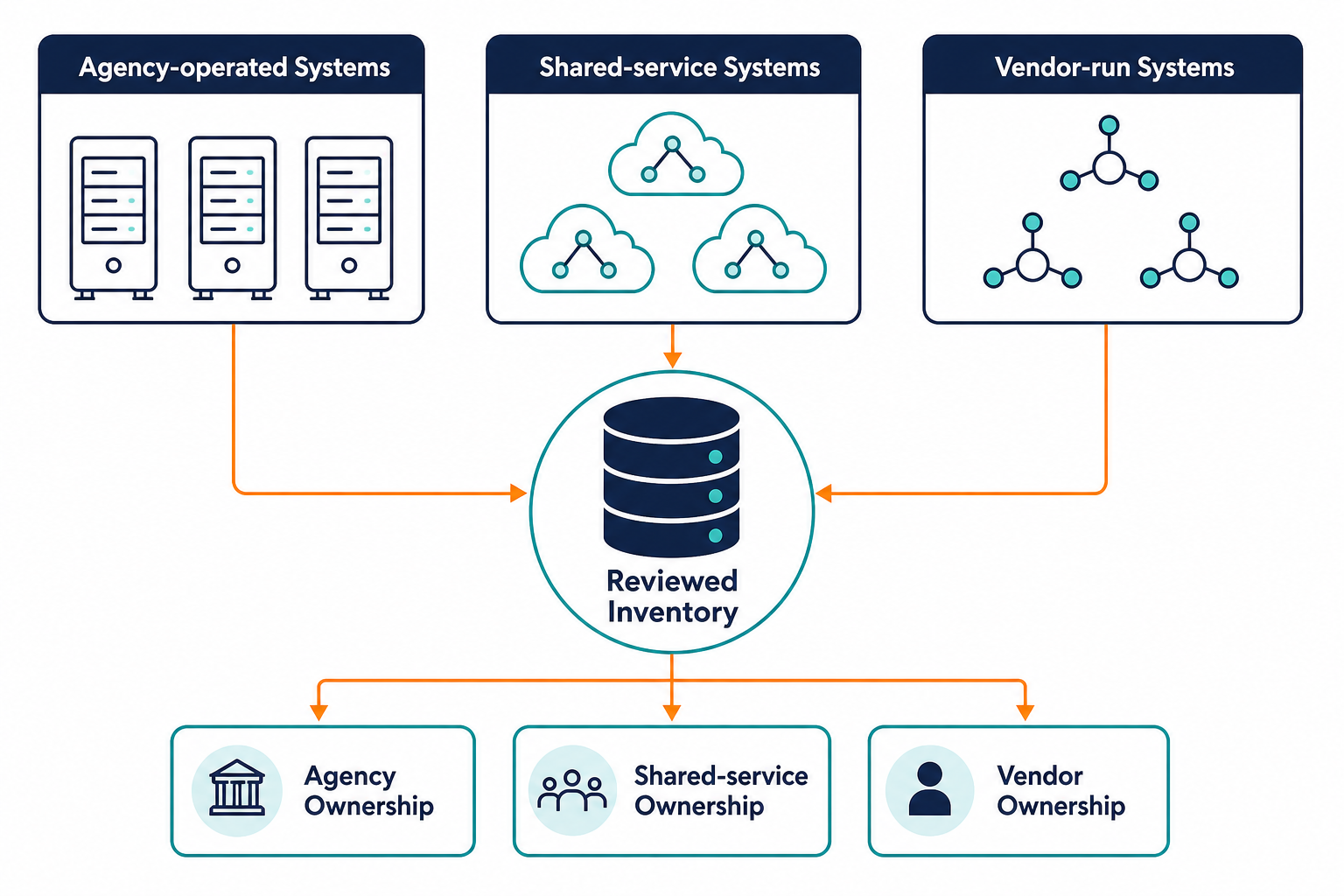
Agency-run and shared-service servers
An agency-operated server may have a local infrastructure owner. A shared-service server may have a provider responsible for operation and an agency contact responsible for the consuming service.
Scheduled IT discovery for agency servers can identify supported systems within the configured network scope.
The record should distinguish those roles. It should also identify the source that supplied the server details and the date they were last confirmed.
Vendor-run systems
A vendor may operate the platform while the agency owns the business relationship and manages the contract. The agency’s record can identify the service, vendor contact, contract reference, data involved, and internal owner.
Those fields do not reveal the vendor’s internal infrastructure. They give agency staff a starting point for requesting evidence from the provider.
Program cloud accounts
A program team may create an account for a specific application or project. The inventory should associate the account with its purpose, agency owner, and review date.
When an account no longer supports its original purpose, the responsible owner can decide whether it should remain active. The CMDB owner then records the approved lifecycle change.
AI-enabled applications
The 2026 IRDR includes an AI inventory for state agencies. Program and application owners must supply information about systems with AI components and their purpose.
Discovery of underlying infrastructure does not establish whether an application meets the state’s AI reporting criteria. That classification requires review by agency staff.
Retired systems
An old spreadsheet can retain an entry after a system has been removed from service. The system owner should decide the disposition, and the IRM should confirm the reporting treatment.
Mark the record with its retirement decision and date. Preserve the history according to agency policy rather than treating an absent discovery result as permission to delete it. Record any related contract end date and the person who confirmed the system was removed from service.
What the EMA Benchmark Says About Reconciling Asset Data
Finding a server is one part of an inventory. Resolving conflicting descriptions of that server requires an agreed source for each field.
Enterprise Management Associates’ October 2026 ITAM maturity benchmark asked respondents to name their single biggest discovery and asset-data gap. Of 203 respondents, 31.0% selected integration, meaning data lived in silos that could not be reconciled into one source. Another 27.1% selected stale, inconsistent, or untrustworthy data.
The research was sponsored by Virima. Its respondents were North American IT professionals at organizations with at least 1,000 employees. The survey was not a study of Texas agencies, and the responses describe participants’ reported concerns rather than measured causes.
For an IRM, the useful distinction is between a missing asset and a conflicting record. A server can appear in a shared-service list, an agency inventory, and a change ticket while carrying different owner names in each.
The agency can assign authority by field. For example, the infrastructure provider may supply operating-system details, while the agency confirms the business owner. A reviewer should retain the source and review date so a later reporting team can understand how the value was established.
A single record still needs a process for resolving exceptions. An unresolved ownership conflict should remain visible until the responsible parties agree on the answer.
How can an agency handle conflicting server owners?
An agency can record both the operational provider and the internal service owner when their responsibilities differ. If two sources disagree about either role, the IRM can route the exception to the relevant service lead. The disputed field should remain flagged until the responsible parties confirm it.
IT Asset Visibility for Texas State Agencies in Austin Across Four Reports
A server record can support several reporting activities, but each activity asks a different question. The inventory provides supporting facts; agency staff still prepare the response and apply the relevant state instructions.
| Reporting activity | Question for the agency | Helpful record fields |
|---|---|---|
| IRDR inventory | Which devices and applications are within the agency’s reporting scope? | Asset identifier, type, source, and owner. |
| Infrastructure risk assessment | How has the agency rated server failure likelihood and impact? | Server identity, confirmed rating, rating date, and reviewer. |
| Information security plan | Which systems and owners support the agency’s security work? | System owner, service relationship, and supporting evidence location. |
| Cybersecurity and legacy project prioritization | Which applications and systems are associated with a proposed project? | Application, affected system, project owner, and lifecycle state. |
Review Trusted Runtime Truth for operations to see what exists, how it connects, what changed, what may break, and who owns it. Agency staff can use that context when reviewing the records behind each submission.
DIR’s 2026 assessment methodology assigns the server inventory and AI inventory 10% each of the combined assessment score. The agency rates server failure probability and impact on scales from one to five. DIR uses those ratings in its server-risk calculation.
The methodology identifies agencies below its 50% thresholds as higher risk and requires remediation plans for applicable deficiencies. A better-maintained inventory supports the review, but it does not establish an agency’s score or satisfy the reporting requirement by itself.
The information security plan asks for security objectives and supporting assessments. Those require input from the agency’s information security officer and other responsible staff. A server record can point to evidence, but it cannot substitute for a completed assessment.
For project prioritization, the agency must describe the proposed cybersecurity or modernization work. A record linking a legacy application to its supporting systems can help staff identify which assets need review.
SPECTRIM remains the state reporting portal. Virima does not submit these responses to SPECTRIM. Agency staff must enter, review, and submit their own information.
IT Asset Visibility for Texas State Agencies in Austin From One Discovery-Sourced Record
IT asset visibility for Texas state agencies in Austin depends on the coverage and authority of each source. A discovery cycle can observe supported infrastructure within its configured scope. Agency owners must supply or confirm information that discovery cannot establish.
Virima supports agent-based, agentless, and API-based discovery for supported resources. Teams configure scheduled discovery at a team-set frequency. Agentless collection requires appropriate network connectivity and credentials.
| Inventory task | Available approach | Agency review |
|---|---|---|
| Identify supported infrastructure | Use configured agent-based or agentless discovery. | Confirm network scope, access, and collection results. |
| Collect cloud asset information | Use supported AWS or Azure connections. | Confirm authorized accounts and applicable permissions. |
| Inventory installed software | Collect supported software details from in-scope systems. | Review coverage and exceptions with system owners. |
| Reconcile records | Combine supported source data using defined authority rules. | Resolve conflicts and confirm business ownership. |
| Track lifecycle and contracts | Maintain asset lifecycle and contract information. | Confirm renewal and retirement decisions with responsible staff. |
| Share records with workflows | Use supported service-management integrations or exports. | Check the fields and direction available for each connection. |
The supported integration catalog lists connections including ServiceNow, Jira Service Management, Ivanti, HaloITSM, Xurrent, Hornbill, and TeamDynamix. An agency should confirm the fields, permissions, and synchronization behavior for its chosen connection.
Virima also provides a REST API and reporting exports for supported records. An agency should validate its intended export format and review any security restrictions before moving inventory data between systems.
Discovery coverage depends on configured access and scope. A vendor-run service may be represented by information the agency supplies, without access to the vendor’s internal platform. AI system classifications also require agency-supplied information. The inventory supports reporting work; it does not provide legal advice, replace security controls, or establish regulatory compliance.

What One Maintained Record Can and Cannot Cut
A maintained inventory gives an IRM a consistent starting population. Its value depends on whether the agency can explain the scope, resolve exceptions, and confirm the fields used in a report.
The EMA benchmark also asked about asset information in audit preparation and defense. In that survey, 56.7% described IT asset management information as critical. Another 39.4% said it was useful but fell short of being fully audit-ready. These are survey responses, not results from Virima customers or Texas agencies.
An agency can measure its own inventory process without assuming a time-saving result:
- Owner and freshness coverage: Divide in-scope servers with a confirmed owner and an observation inside the review window by all in-scope servers.
- Missing records: Count systems named in a report that cannot be matched to an inventory record.
- Vendor accountability: Count vendor-run systems with a confirmed internal agency owner.
- Unresolved conflicts: Count records where sources disagree on ownership, lifecycle, or service relationship.
The IRM should define the population and review window before comparing results across periods. A rising coverage percentage can reflect a narrower scope unless the denominator stays visible.
Why should an agency track the denominator in inventory coverage?
A coverage percentage can rise when an agency removes systems from the measured population. Recording the number of in-scope systems alongside the percentage makes that change visible. The information resources manager can then distinguish a scope change from an improvement in confirmed ownership or observation dates.
Ownership Map Before the Next Report
The following map gives agency staff a starting point for assigning responsibility. Actual assignments should follow the agency’s policies, contracts, and service agreements.
| Record type | Who supplies the facts | Who confirms them | Who decides retirement |
|---|---|---|---|
| Agency-run server | Infrastructure team and discovery records. | System owner and IRM. | Agency system owner. |
| Shared-service server | Shared-service provider and agency service team. | Agency service owner with the provider. | Accountable owner under the service agreement. |
| Vendor-run system | Vendor and agency contract manager. | Agency business or system owner. | Agency owner under the contract process. |
| Cloud account | Cloud account team and supported connection. | Agency account or program owner. | Account owner under agency policy. |
| AI-enabled application | Application and program owners. | Agency owner responsible for the AI inventory. | Application owner under agency policy. |
| Retired system | System owner and retirement documentation. | IRM confirms reporting treatment. | System owner approves the disposition. |
For shared and vendor-run services, the agency should record both the internal accountable owner and the external operator. A contract can define who supplies updates and when the agency reviews them.
Discuss your agency’s inventory needs with Virima, including the records your staff maintains and the sources available to support them.
Frequently Asked Questions
What is a CMDB for state government?
A configuration management database stores selected records about systems and their relationships. A state agency can use those records to connect a public service with its supporting infrastructure, while controlling access to sensitive inventory information.
Why do Texas state agencies keep an IT server inventory?
Texas collects server inventory information as part of its infrastructure reporting. Agencies can also use individual server records to identify unsupported systems, plan replacement work, and locate the staff responsible for reviewing proposed changes.
What should an agency record for a vendor-run system?
Record the service name, internal owner, vendor contact, contract reference, and the data or services involved. Add the location of the vendor’s supporting evidence, subject to the agency’s security and records-handling policies.
Who owns an agency asset record after the Texas Cyber Command transition?
The agency assigns its own asset-record responsibilities under its policies and agreements. Texas Cyber Command manages statewide cybersecurity functions, while DIR manages the IRDR. Those state roles do not appoint an owner for each agency record.
How often does Virima discovery refresh an agency inventory?
Discovery runs on a schedule configured by the team. Before selecting a frequency, agency staff should consider network access, maintenance windows, and how quickly each asset class changes. Failed collection attempts also need follow-up.