How to streamline your IT operations with Virima ITSM solution

Your IT team juggles dozens of incidents, change requests, and service tickets every week. Without a structured system, those pile up fast. Resolution times creep higher, the same problems keep resurfacing, and changes break things nobody saw coming.
Virima’s ITSM platform brings order to that mess. It ties IT services to business goals, shortens incident resolution times, and gives your team the process guardrails to manage changes without causing new outages.
ITSM is one layer of Virima’s broader IT visibility platform, which combines IT discovery, an automated CMDB, and ViVID™ service mapping to give teams the operational context they need for every IT decision.
This article focuses on the ITSM capabilities: incident and problem management, change management with ViVID™, service catalog, knowledge management, SLA tracking, reporting, and how Virima feeds infrastructure context into ITSM tools like ServiceNow and Jira Service Management.
What role does a CMDB play in IT service management?
A CMDB is the foundation of every ITSM process. It stores configuration items (CIs) data, servers, applications, and network devices, along with the relationships between them. Incident teams need to know which CIs are affected. Change managers need to see downstream dependencies before approving a modification. Problem managers need to trace root causes across infrastructure layers.
Virima keeps your CMDB accurate through continuous IT discovery. Your ITSM workflows run on current data, not a spreadsheet someone last touched six months ago.
ITIL-aligned: Built to support ITIL best practices
Virima covers Incident, Problem, Change, Configuration, Knowledge, and Request Fulfilment in a single ITIL-compliant platform.
Virima ITSM is ITIL-compliant and supports the full set of ITIL processes out of the box: Incident, Problem, Change, Configuration, Knowledge, and Request Fulfilment.
The platform shortens incident resolution times, routes changes through automated approval workflows, and surfaces real-time dashboards so you can measure service quality against your SLAs.
Standardized workflows mean every team member follows the same process from ticket creation through resolution. That consistency matters. It’s the difference between a service desk that handles 200 tickets a week cleanly and one where half the tickets get rerouted because someone skipped a step.
Incident management: Track, prioritize, and resolve faster
When incident management is ad hoc, the same issues keep showing up. Your team spends its energy firefighting instead of fixing the underlying cause. Virima ITSM gives you centralized incident tracking from detection through resolution.
Runbook automation
Runbooks let you automate repetitive tasks based on specific conditions. For incident management, that means predefined response steps fire automatically when a known issue triggers, a password reset upon request, a server reboot after a patch update, or an escalation workflow for a critical alert.
What that looks like in practice:
- Faster response times because automated steps execute right away
- Fewer human errors since responses follow a tested script
- Consistent handling across shifts, whether it’s your most experienced engineer or someone covering on a weekend
Business service rules
Business service rules automate admin and routing functions across Virima. Incidents can be auto-created from email, the self-service portal, and monitoring or event management tools, then assigned based on type, severity, and SLA requirements. Rules can also reclassify incidents that were logged incorrectly, turning a misrouted incident into a service request and sending it to the right queue.
Your team starts working on the actual fix sooner because the handoff is already done.
Read: Virima ITSM: Improve Incident Management and Resolution Time
| How does Virima ITSM reduce incident resolution time? Three things work together here. Runbook automation handles routine response steps for known issues, reducing manual effort on repeatable tasks. Business service rules assign incidents to the right team based on type, severity, and SLA requirements, cutting out misassignment delays. And because incidents tie directly to CMDB assets and appear on ViVID Service Maps, responders can see which CIs are affected, who the stakeholders are, and what depends on the impacted system. Virima combines all three to cut mean time to resolution (MTTR). Automated task handling, smart routing, and real-time dependency data working together is what actually moves the needle on resolution speed. |
Problem management: Fix root causes, not just symptoms
Most IT teams are stuck in reactive mode. An incident fires, someone fixes the immediate symptom, and the underlying problem stays untouched until it causes the next outage. Virima ITSM helps break that cycle.
Because incidents can be tied to CMDB assets and reflected on ViVID Service Maps, problem managers gain visibility into which infrastructure components are involved in recurring issues. When the same CI keeps showing up in incident records, it signals a deeper problem worth investigating — not just another ticket to close.
That visibility is what shifts problem management from reactive to proactive. Instead of waiting for the next outage, your team can trace patterns back to root causes and build a case for the infrastructure fix.
Change management: Control changes with automated workflows
Uncontrolled changes are behind most IT outages. A team pushes an update, something downstream breaks, and nobody realizes the dependency existed. Virima’s change management workflows add structure and approval gates to prevent exactly that.
How does service mapping improve change management?
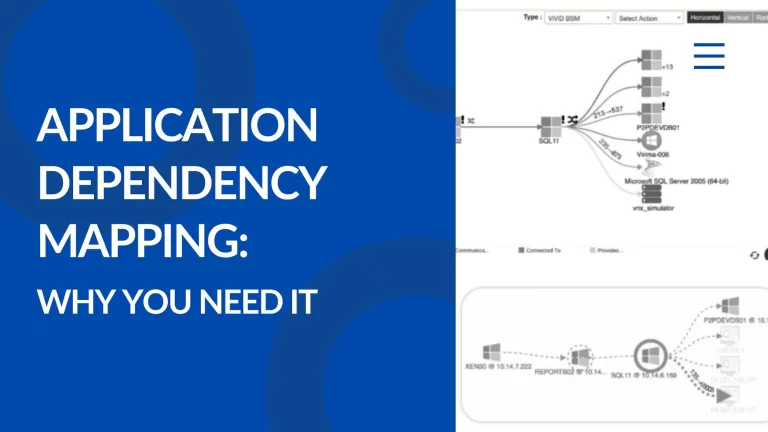
ViVID™ service mapping plugs directly into the ITSM platform and shows the blast radius of any proposed change. Before approving a database server upgrade, your team sees every application and business service that depends on it. If the upgrade could impact three critical services during business hours, that’s visible before the change goes live, not discovered after the outage call starts.
ViVID maps also overlay open incidents, recent changes, pending changes, and NIST NVD vulnerabilities directly onto the CIs they affect. That means change managers aren’t just seeing dependencies; they’re seeing which assets already have active incidents or known vulnerabilities, so they can factor that into the risk assessment.
The platform also tracks which changes are pending approval and from whom, so stakeholders stay aligned throughout the change lifecycle.
Also read: A Guide to Change Management for Modern IT Organizations
Service catalog: define, publish, and manage IT services
Virima ITSM includes a self-service portal where users browse published service offerings, read service descriptions, and submit requests. IT teams can track approvals and fulfillment status for every request. Fewer ad hoc emails asking “who do I talk to about X?” and a clear record of what was requested, when, and by whom.
Knowledge management: build a centralized knowledge base
Virima ITSM includes Knowledge Management as a core ITIL-compliant module, alongside the self-service portal that helps reduce calls to the help desk.
When users can find answers through the portal instead of filing a ticket, help desk volume drops. When agents can pull from a shared knowledge base instead of reinventing the fix each time, resolution time drops. Both outcomes show up in your SLA metrics.
Reporting and dashboards: real-time visibility into ITSM performance
Virima ITSM lets you define and track SLAs with specific targets for response time, resolution time, and escalation thresholds customized per service type.
Customizable dashboards and reports surface those metrics in a readable format. You can track trends, spot bottlenecks, and give stakeholders the numbers they need to make resourcing decisions without digging through raw data.
These reports also support governance and audit readiness. Because Virima’s CMDB is continuously updated through automated discovery, your configuration and asset management data stay current. When auditors need evidence of data flows, system communications, or infrastructure state at a given point in time, the data is already there, not something your team has to scramble to reconstruct.
What ITSM integrations does Virima support?
Virima integrates with major ITSM platforms to feed infrastructure context discovery data, CI relationships, and service dependency maps directly into your ticketing workflows. Out-of-the-box integrations include:
These integrations keep your ITSM workflows current with infrastructure changes. No manual syncing, no stale CI data in your tickets.
Start using Virima ITSM
Virima ITSM delivers ITIL-aligned incident and problem management, change management backed by service mapping visibility, a self-service catalog, centralized knowledge, SLA tracking, and real-time reporting, all built on a foundation of automated IT discovery and an always-accurate CMDB.
Whether you run Virima as your end-to-end ITSM platform or plug its discovery, CMDB, and service mapping into an existing ITSM tool, the result is the same: your team operates on infrastructure data they can trust.
Contact Virima today to see how the platform fits your environment.
Frequently asked questions
How are incidents created in Virima ITSM?
Incidents can be created automatically from email, the self-service portal, and system monitoring or event management tools. They can also be logged manually. Business service rules handle routing and assignment based on type, severity, and SLA requirements.
How often does Virima Discovery update the CMDB?
Virima Discovery is a set-and-forget tool. You schedule it to continually rescan your IT environment, capturing new assets and checking existing ones for configuration changes between scans.
Can Virima verify configurations before and after a change?
Yes. Virima Discovery can confirm infrastructure configurations both before and after a change is executed. This gives change managers evidence that the change was applied correctly and that no unintended configuration drift occurred.
Can end users track their own service requests?
Yes. The self-service portal lets users submit requests for published services and track approvals. Users can also report new outages, confirm previously reported issues, and check known issues affecting service availability.
Does Virima ITSM track MTBF in addition to MTTR?
Yes. Virima ITSM helps you monitor and evaluate IT service performance to decrease MTTR (mean time to resolution) and improve MTBF (mean time between failures).
Does Virima integrate with tools beyond ITSM platforms?
Yes. Beyond the ITSM integrations listed above, Virima supports dozens of other integrations, including monitoring, alerting, warranty, and event management systems, plus cloud platforms like AWS and Azure. If your tool isn’t listed, Virima’s flexible APIs can support custom integrations.
Does Virima replace my existing ITSM platform?
No. Virima feeds infrastructure context — discovery data, CI relationships, and service maps — into your existing ITSM platform. Tools like ServiceNow, Jira Service Management, or Ivanti continue to manage tickets and workflows. Virima provides the infrastructure visibility and operational context layer.