
CMDB Automation for Austin Cloud-Native Engineering Teams Starts With What Not to Record

 Summarize with ChatGPT
 Summarize with Claude
Key Takeaways
- Keep cluster and service records when they support ownership, change, or incident decisions.
- Leave short-lived workload detail in platform tools unless a specific operational need warrants a record.
- Review discovery scope and observation dates before using a configuration record for a change.
A retired component can remain in production after its security updates stop. CMDB automation for Austin cloud-native engineering teams starts with identifying the records that help people find affected services and owners.
Kubernetes retired Ingress NGINX on March 24, 2026. The project receives no further releases, bug fixes, or security updates. Existing deployments can continue to function, so teams must check their environments and plan their migration.
The retirement creates a practical inventory question: which clusters need investigation, and who can confirm their configuration? A configuration management database (CMDB) can hold cluster ownership and service relationships for that review. Platform tooling remains necessary to verify which clusters run a particular controller.
The useful record is one that helps someone make a decision. Thousands of short-lived entries can obscure that decision when the durable cluster or service has no confirmed owner.
Why Austin Cloud-Native Teams Face the Granularity Question
Austin’s technology workforce spans software development, infrastructure, and business roles. CompTIA’s 2026 workforce forecast projected 5,676 additional tech jobs in the Austin metro area during 2026. That figure is a forecast across CompTIA’s definition of tech employment, not a count of cloud-native engineers.
For a platform organization, the relevant question is how responsibility travels across teams. One group may administer cloud accounts, another may operate clusters, and a third may own the customer-facing service.
Each group needs enough shared information to coordinate a change. The platform team also needs detailed workload information that would overwhelm a service-level record if copied indiscriminately.
A CMDB owner can begin with the decisions the record must support. Change approval may require the cluster, its owner, and affected services. Incident investigation may require those fields plus a link to the platform team’s diagnostic tools.
The record should identify the source and observation date for its attributes. A team can then judge whether the information is suitable for the decision at hand.
Explore discovery-sourced Trusted Runtime Truth to see how records can describe what exists, how it connects, what changed, what may break, and who owns it.
What a Short-Lived Workload Does to a Record
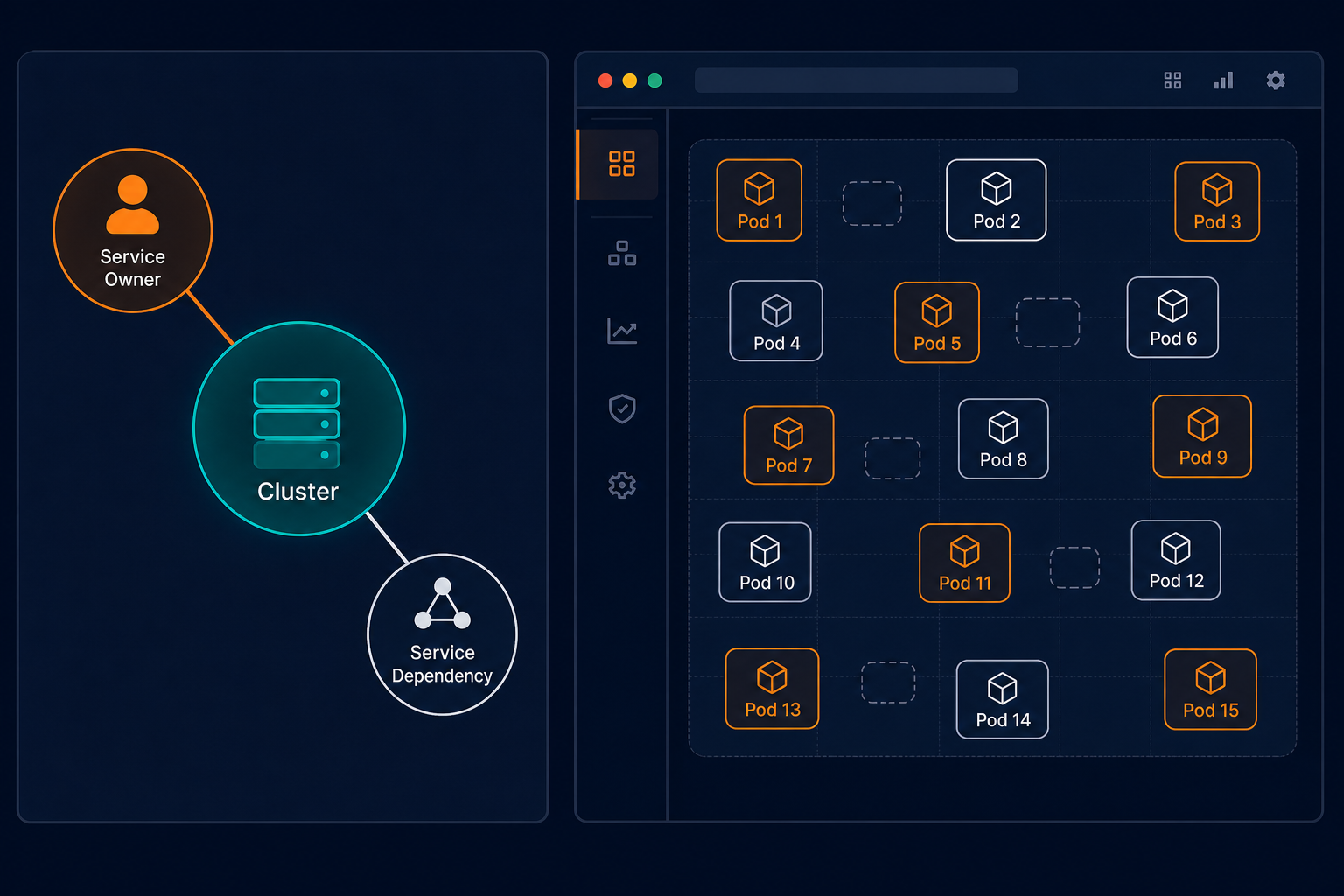
A pod can be replaced while the service it supports remains in use. Recording each temporary instance may create more entries than a CMDB owner can review. Platform tools are better suited to examining individual instances during troubleshooting.
A configuration item, or CI, is a record maintained for operational use. The table below offers a starting point for deciding which records merit that attention.
| Layer | Typical lifespan | Record it? | Who decides? |
|---|---|---|---|
| Cloud account | Often months or longer | Usually, with account context and an owner. | Cloud account owner and CMDB owner. |
| Cluster | Often months or longer | Usually, when it supports managed services. | Platform lead and CMDB owner. |
| Namespace | Varies by team and purpose | When it has a distinct operational use. | Platform lead, with CMDB owner approval. |
| Service | Often outlasts individual workloads | Usually, when teams manage it as a service. | Service owner and CMDB owner. |
| Pod or short-lived job | May be brief or repeatedly replaced | Usually leave instance details in platform tools. | Platform lead, with CMDB owner approval. |
| Owner team | Changes with responsibility | Record and confirm the accountable team. | Service or platform lead. |
| Service dependency | Changes with architecture | Record when it informs an operational decision. | Service owners confirm the relationship. |
These are decisions for the organization, not fixed retention rules. A stateful workload may justify closer attention when its identity or storage affects recovery. The platform lead should propose the scope, and the CMDB owner should approve how it is maintained.
When should a namespace become a configuration item?
A namespace may warrant a configuration item when it has an identifiable owner or a distinct change boundary. The platform lead should define what decision the record supports and how it will be reviewed. Namespaces used only for temporary testing may be better tracked in platform tooling.
What the Evidence Says About Container Discovery
The October 2026 EMA ITAM maturity benchmark reports that 12.8% of surveyed organizations used dedicated discovery tools for containers and Kubernetes workloads. Virima sponsored the research.
Enterprise Management Associates surveyed 203 North American IT professionals at organizations with at least 1,000 employees. The finding describes reported use of dedicated tools. It does not measure total container visibility or the proportion of workloads discovered.
CMDB automation for Austin cloud-native engineering teams depends on a clear division of responsibilities. A team may inspect workloads through its platform tools without treating individual instances as CMDB records. Another may have a dedicated discovery tool but still need people to confirm ownership and reconcile conflicting sources.
For an Austin engineering team, the benchmark is context for a design discussion. It does not establish how many local organizations use Kubernetes or how their CMDBs are configured.
A useful review starts with the source for each operational question. The cloud account may provide the account identifier. The platform team may confirm cluster configuration. A service owner can confirm which business service depends on that cluster.
Those answers can be recorded together without copying every workload instance into the CMDB. The team should document which fields come from discovery and which require human review.
Does a discovery-tool survey measure total Kubernetes visibility?
A survey about dedicated discovery tools measures the practices respondents report for those tools. Teams may also inspect Kubernetes workloads through other platform systems. Compare the survey question and population before using its results to assess a particular organization’s coverage.
Four Ways Records Go Wrong in a Cluster-Heavy Estate
1. Temporary instances crowd out useful records
A CMDB filled with short-lived pod entries can make review queues harder to navigate. The CMDB owner should compare the volume of those entries with the decisions they support.
Field to review: The last-seen date helps identify records that no longer appear in the configured discovery scope. It does not establish whether the resource was intentionally retired.
2. A cluster keeps an outdated owner
A team reorganization can leave a cluster record assigned to a group that no longer operates it. The platform lead should identify the receiving team and ask that team to confirm responsibility.
Field to review: The owner field should name an accountable team and include a review date.
3. A project account loses its review path
An account created for a project may remain in the inventory after the project ends. The cloud account owner should confirm its purpose and determine whether its resources still need support.
Field to review: Lifecycle state shows whether the account is active, under review, or approved for retirement.
4. A service record misses a dependency change
A gateway or controller change can alter the information needed for a service review. The service owner should confirm the affected relationship with the platform team before the CMDB owner updates the record.
Field to review: The relationship review date shows when a person last checked the recorded dependency.
For retirement, flag the item with a timestamp rather than immediately deleting its history. The service owner decides the disposition, with CMDB owner sign-off on the record update.
How CMDB Automation for Austin Cloud-Native Engineering Teams Stays Focused
A smaller record set still needs a reliable collection and review process. Virima supports agent-based, agentless, and API-based discovery for supported resources. Its cloud connections include AWS and Azure.
The Virima supported integration catalog lists available connections. Teams should confirm the fields, permissions, and synchronization settings applicable to their deployment.
| Record task | Approach | Review owner |
|---|---|---|
| Collect supported cloud data | Configure AWS or Azure connections and account scope. | Cloud and discovery owners. |
| Match observations to records | Apply configured reconciliation and source-authority rules. | CMDB owner. |
| Maintain ownership | Use available source data and confirm accountability with teams. | Service or platform owner. |
| Review record quality | Examine completeness, staleness, and unresolved exceptions. | CMDB owner. |
| Manage lifecycle | Record review and retirement decisions with dates. | Service owner, with CMDB owner sign-off. |
Run scheduled discovery at a frequency the team sets for its environment. A short-lived workload can appear and disappear between cycles. A failed collection can also leave a record older than expected.
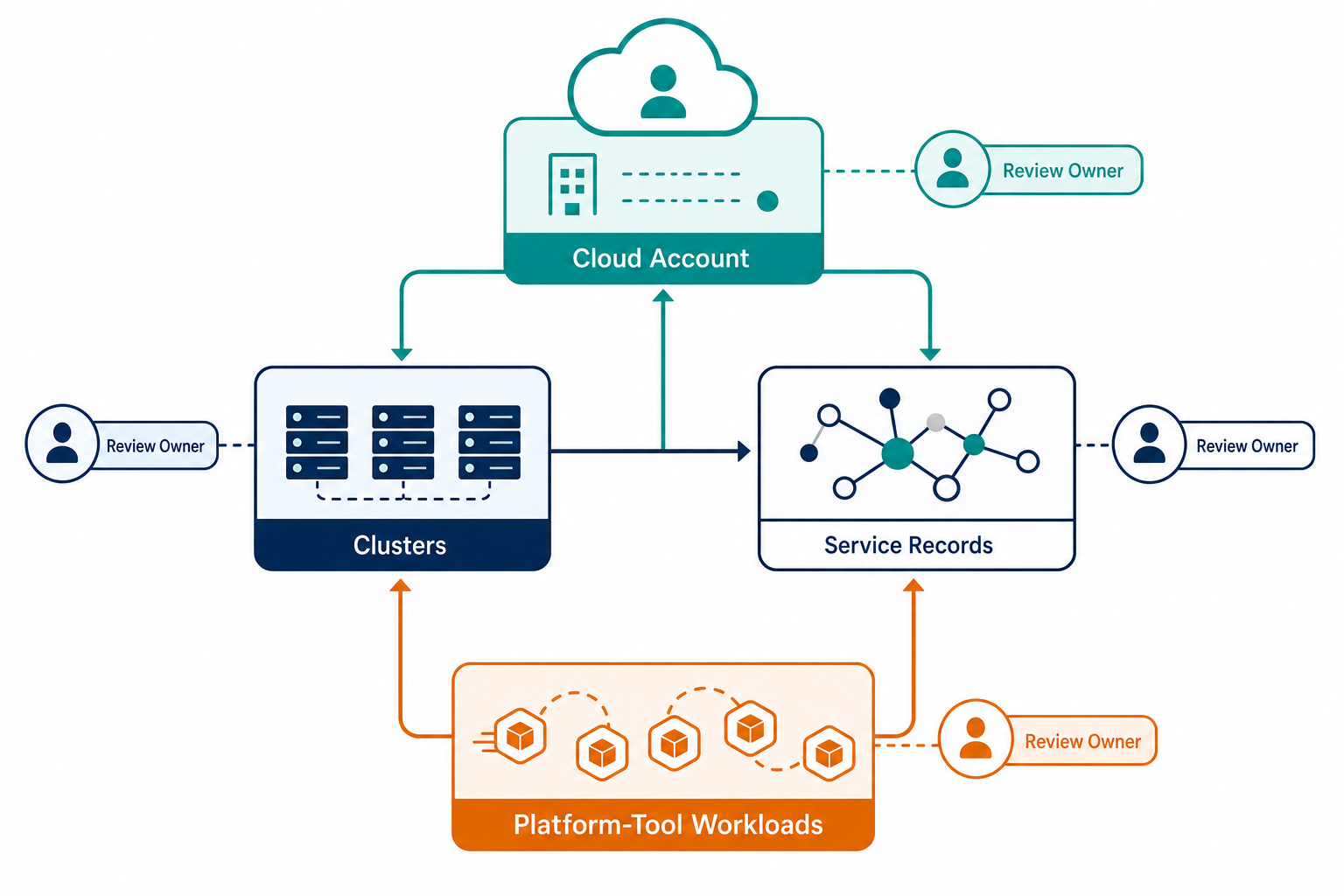
Before expanding the scope, agree on the fields that support a decision. Cluster identity, account, owner, lifecycle state, and last successful observation provide a practical starting point. The platform team can retain detailed workload diagnostics in its existing tools.
Virima’s published Kubernetes material discusses pods and namespaces. Confirm the available discovery attributes and retention settings for your deployment before designing rules around them. Use platform tooling to verify controller installations and investigate short-lived components.
What the Record Can Show After a Retirement Notice
A retirement notice gives teams a reason to review cluster and service records against current platform evidence.
Start with the cluster list and its accountable teams. Ask each platform owner to check whether the retired component is present. Record the result and review date in the system your team uses for migration tracking.
Next, identify services associated with affected clusters. A documented relationship can help a change reviewer find service owners who should participate in the migration. The reviewer should confirm gaps with those owners before treating the relationship list as complete.
ViVID™ builds dependency maps after the team supplies service definitions. A map’s usefulness depends on available relationships, configured discovery scope, and the age of its underlying information.
The retirement notice does not establish a CMDB failure. It also does not prove that a CMDB can identify every controller installation. Platform checks provide the evidence for that question.
What should a retirement review record alongside a cluster?
A retirement review should record the person who confirmed the finding and the date of that confirmation. It should also identify the migration decision and the location of supporting platform evidence. These fields let a later reviewer distinguish a completed check from an unverified assumption.
What One Maintained Record Can Help Measure
CMDB automation for Austin cloud-native engineering teams needs measures tied to their own records. Start with the share of in-scope clusters that have both a confirmed owner and a recent successful observation.
Define the review window before calculating the result. A production cluster might need a different window from a test environment. Record failed collections separately so that an old observation does not appear current.
For example, if 80 of 100 in-scope clusters meet both conditions, the team’s measure is 80%. That example illustrates the calculation and does not represent a Virima customer result.
Review the exceptions with platform leads. An unowned cluster needs an accountability decision. A cluster outside discovery scope needs a documented reason or a collection plan.
Use the same scope and definition in later reviews. Otherwise, a change in the percentage may reflect a changed population rather than better record maintenance.
Record-or-Leave-It Clinic
Should every namespace become a CI?
Record a namespace when it supports a distinct ownership, change, or service decision. The platform lead should propose the scope, and the CMDB owner should approve the record policy.
Where should feature-flag service details go?
Keep the operational service relationship where change reviewers can find it. Retain individual flag settings in the tool used to manage them, unless the team has a documented reason to record them elsewhere.
Who decides when a retired cluster record changes?
The service or platform owner confirms the cluster’s disposition. The CMDB owner signs off on the lifecycle update and preserves the agreed history.
What happens when a cluster has no confirmed owner?
Assign the exception to the platform lead for investigation. Keep the owner field unconfirmed until a responsible team accepts it.
How should a team handle a missed discovery cycle?
Record the failed collection and investigate access or scope. Use the previous observation date when assessing whether the record is suitable for a change.
Decide which cluster and service records your team needs to maintain. Explore your discovery options with Virima.
Frequently Asked Questions
What is a CMDB for Kubernetes environments?
A CMDB for Kubernetes environments stores selected configuration records and their relationships. Teams can use it alongside platform tools to connect managed clusters with accountable owners and services involved in operational decisions.
Why might a team leave individual pods out of its CMDB?
Pods can be replaced frequently, creating records that require review after the instances disappear. Teams can keep instance-level diagnostics in platform tools and retain records that support service or cluster decisions.
What should cloud-native teams record in a CMDB?
Useful starting records include cloud accounts, managed clusters, services, confirmed owners, and selected dependencies. Teams should choose fields according to their change and incident workflows, then assign responsibility for reviewing them.
Who owns a cluster record in Virima?
The organization assigns responsibility for each cluster. Virima can store ownership information, while the platform or service lead confirms the accountable team, and the CMDB owner maintains the agreed record process.
How often does Virima discovery refresh CMDB records?
Teams configure scheduled discovery according to their environment and collection needs. Review the last successful observation and failed collections before relying on a record for a time-sensitive decision.