What Is the Difference Between an Asset Management Tool, Software, System, and Platform?

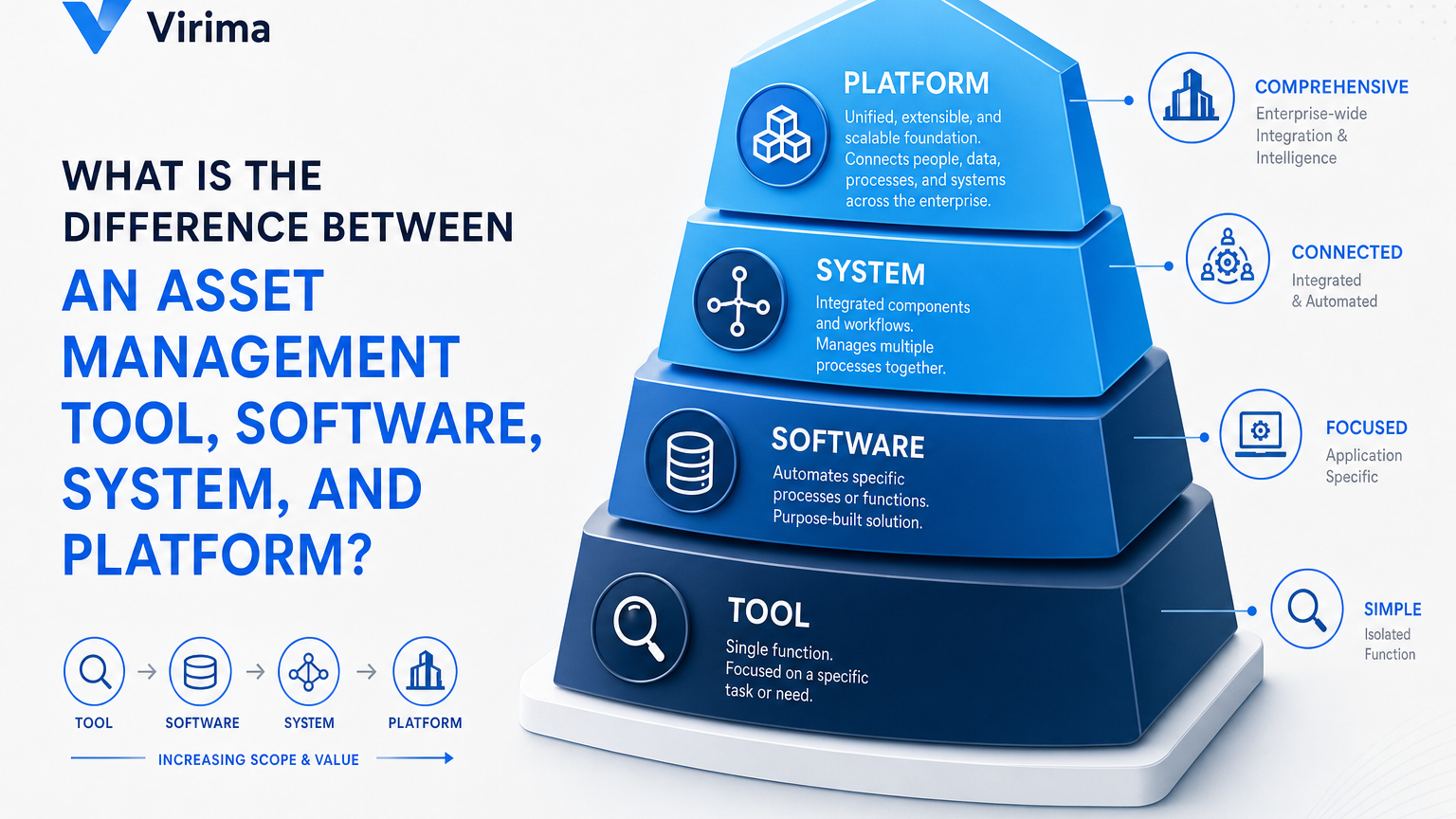
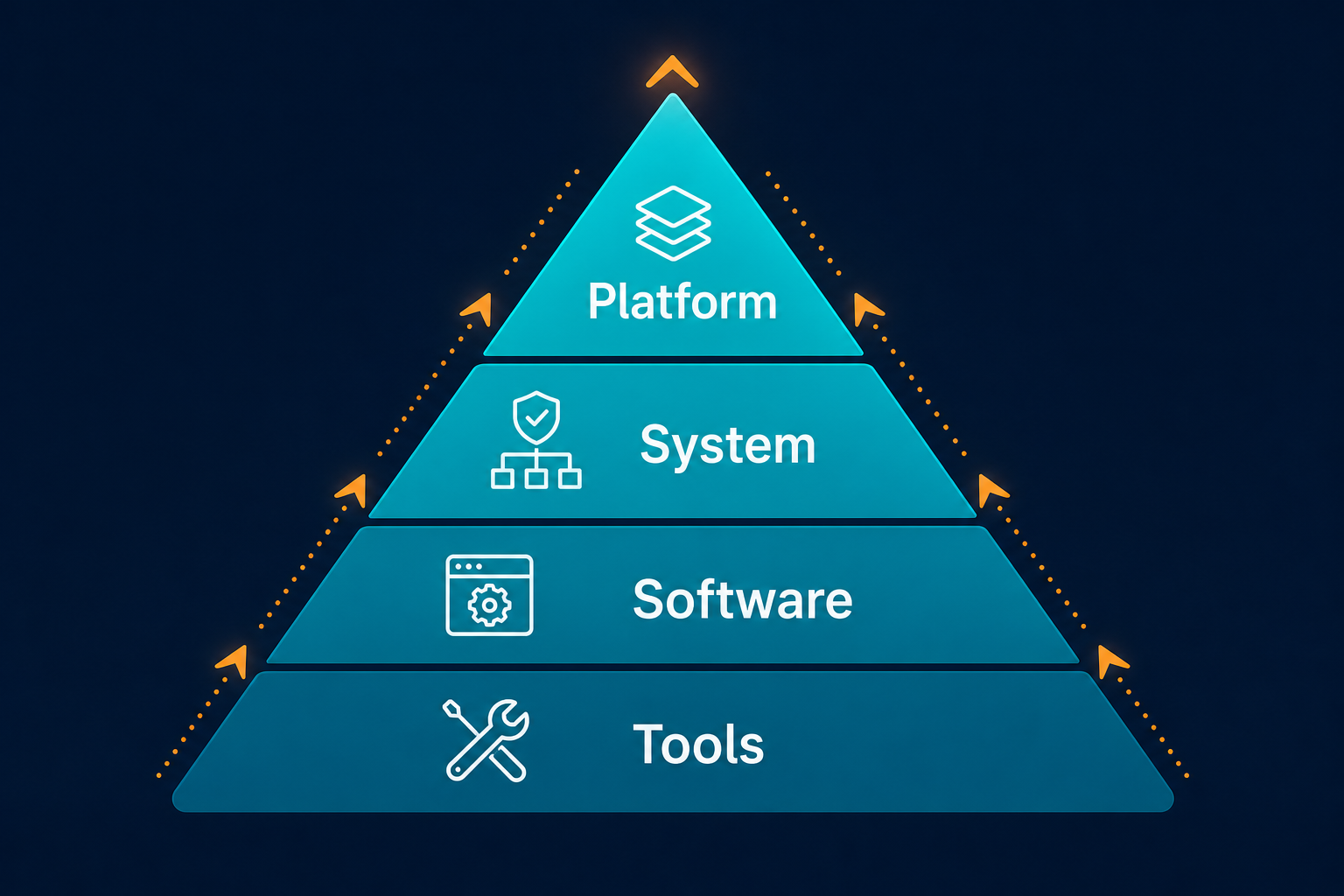
An asset management tool is a single-purpose utility, software is the executable application or service you license, a system adds people, processes, and policies around that software, and a platform integrates multiple operational domains such as discovery, ITAM, and CMDB on a shared data architecture. In vendor marketing, sales teams use these four words almost interchangeably. In actual IT operations, mistaking a point tool for a platform or buying software without building a system causes stalled implementations, data silos, and expensive rip-and-replace cycles.
When IT leaders draft an RFP or evaluate asset management solutions, the terminology often blurs. A vendor pitch might describe a barcode scanner as an enterprise system or market a departmental license tracker as a unified digital platform. Dissecting the genuine technical boundaries between tools, software, systems, and platforms prevents buyers from overpaying for disconnected utilities or underestimating the operational governance required to succeed.
Defining the four terms: tool, software, system, and platform
To cut through product marketing, IT teams must evaluate each tier by architectural scope, integration capacity, and data governance requirements.
A tool performs a narrow, specialized operational task. Point solutions such as handheld barcode scanners, standalone IP subnet ping utilities, network packet sniffer utilities, or isolated software entitlement calculators are classic IT tools. They solve an acute, immediate bottleneck, such as physically auditing a rack in a data center or checking whether a desktop has a particular executable installed. Tools rarely maintain durable lifecycle records, manage organizational change, or communicate natively with enterprise databases.
Software is the commercial application package or SaaS subscription purchased and installed to automate workflows. IT asset management software provides relational databases, user interfaces, role-based access control, reporting engines, and workflow engines. Unlike a single-purpose utility, software manages asset state transitions over time, tracking financial depreciation schedules, purchase orders, vendor warranties, and contract terms. However, software remains inert without defined organizational workflows and operational governance.
A system combines software, hardware, operational processes, people, and compliance policies into a functional management practice. As defined in the National Institute of Standards and Technology hardware asset management guidelines, asset management requires continuous administrative procedures and operational controls alongside technical components. An IT asset management system includes the procurement policies that require purchase order matching, the receiving workflows dock technicians follow, the onboarding and offboarding procedures human resources coordinates, and the disposal standards security mandates. Software is merely the engine inside a broader organizational system.
A platform provides an extensible foundation that hosts multiple modular business and operational capabilities on a shared data model. An enterprise IT operations platform unifies scheduled network discovery, hardware and software asset management, a configuration management database (CMDB), and service dependency mapping. Rather than forcing IT teams to synchronize fragmented databases through fragile point-to-point APIs, a platform uses common identity records, shared discovery engines, and synchronized relationship graphs across every module.
What is the difference between an asset management tool, software, system, and platform?
An asset management tool solves a single operational task like barcode scanning. Software provides the licensed application and database. A system incorporates organizational policies, workflows, and people around the software. A platform unifies multiple modules like discovery, ITAM, and CMDB on one shared architecture.
Four-row terminology comparison: scope, data, and architecture
Comparing these four concepts across technical dimensions highlights where operational boundaries exist.
| Dimension | Tool | Software | System | Platform |
|---|---|---|---|---|
| Primary Scope | Single task execution or point measurement | Automated workflows and lifecycle tracking | End-to-end organizational practice and governance | Multi-domain operational foundation across disciplines |
| Typical Examples | Barcode scanner, subnet pinger, warranty API script | Dedicated ITAM application, license tracking SaaS | Procurement-to-disposal lifecycle governance program | Unified suite spanning IT discovery, ITAM, and CMDB |
| Data Architecture | Flat local file, ephemeral cache, or single table | Relational database with schema for asset records | Enterprise repositories bound by operational policies | Shared data model, unified CMDB, graph relationship layer |
| User Community | Individual technician, engineer, or specialist | ITAM managers, procurement specialists, sysadmins | Cross-functional: IT, Finance, HR, Legal, Security | Enterprise IT Ops, SecOps, Service Desk, C-Suite |
| Integration Model | Standalone, manual file export (CSV), or simple CLI | REST APIs, standard webhooks, scheduled ETL feeds | Process handoffs across ticketing and ERP workflows | Native bi-directional data exchange across all modules |
| Failure Mode | Task failure or localized technician blindness | Shelfware caused by absent adoption or manual data entry | Process breakdown, shadow procurement, policy bypass | Architectural bloat if governance fails to scale |
Understanding this progression prevents organizations from buying software when their true deficit is organizational process, or buying disconnected point tools when their enterprise requires platform-level data reconciliation.
How vendors use these terms in marketing
Vendor websites and marketing collateral routinely inflate terminology to command premium price points and position products above their actual technical architecture.
A common tactic is rebranding an administrative point utility as a “strategic asset management platform.” A vendor providing an agent-based software license optimizer may market their solution as an enterprise asset platform, despite lacking native hardware discovery, network switch interrogation, or configuration item relationship mapping. When buyers purchase these products expecting cross-functional operational visibility, they discover the solution cannot map service dependencies or feed accurate infrastructure states into ITSM workflows.
Another widespread industry pattern is marketing software packages as self-contained “systems.” Sales messaging often implies that installing a modern ITAM SaaS application automatically delivers an IT asset management system. In reality, software cannot enforce procurement compliance if department heads purchase SaaS subscriptions on corporate credit cards without recording contracts. Software cannot ensure data sanitization if retired hard drives leave facilities without documented chain-of-custody handoffs. Software enables a system, but vendors cannot sell you an organizational system out of the box.
Conversely, legacy enterprise suites frequently market monolithic software bundles as unified “platforms.” In practice, many legacy suites represent collections of disparate point acquisitions stitched together with brittle database connectors. Data schemas differ between the discovery tool, the asset register, and the service desk database. Fields fail to synchronize cleanly, hostnames clash across operating environments, and administrators spend hundreds of hours reconciling conflicting inventory feeds. A genuine platform shares one underlying data schema, one discovery mechanism, and one unified truth plane.
To maintain architectural integrity across the IT estate, organizations establish trusted runtime truth across assets, dependencies, and operational workflows.
The operational cost of confusing tools with platforms
Deploying the wrong category of technology for an enterprise requirement incurs measurable operational friction and compounding financial overhead.
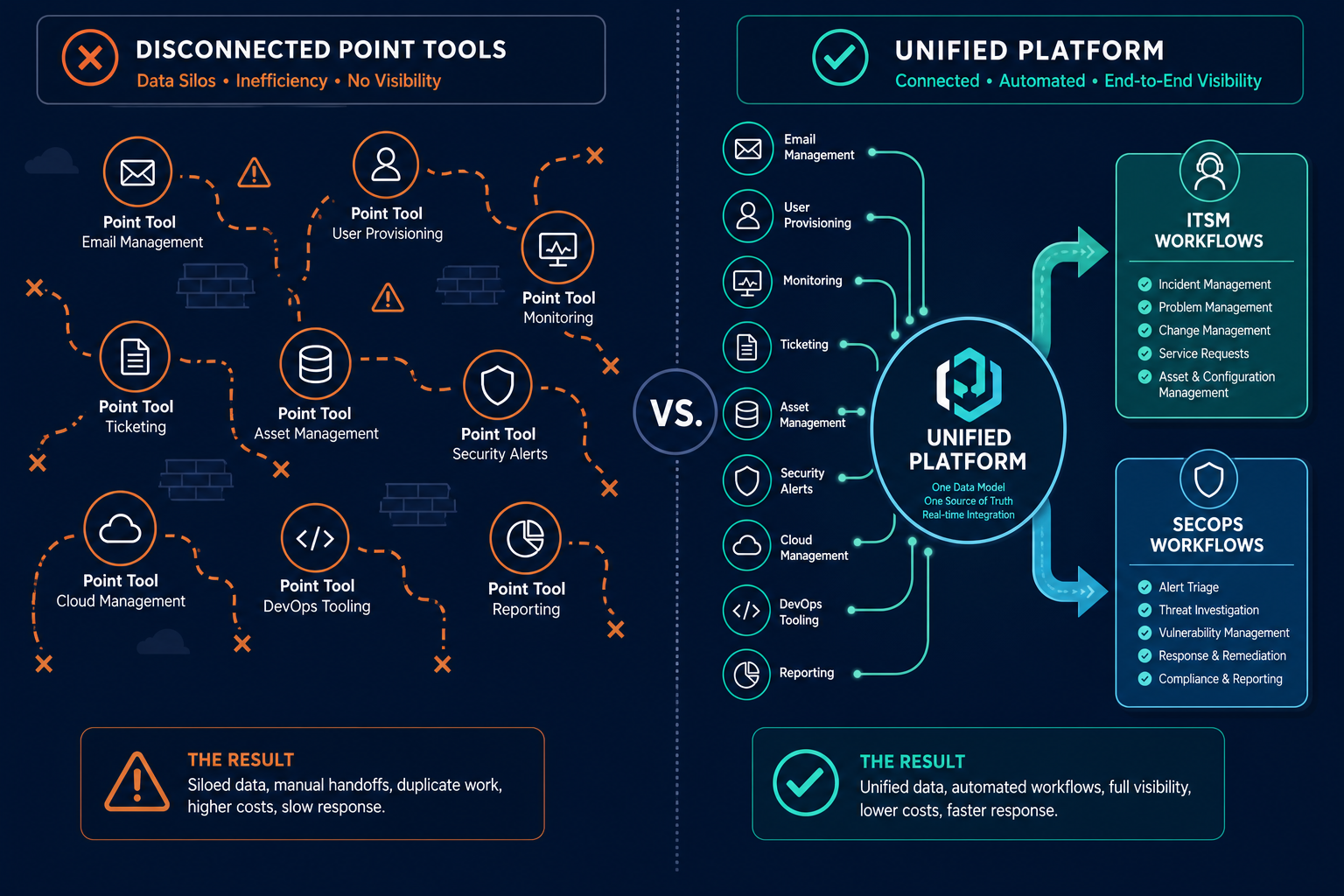
When an enterprise attempts to scale IT operations using isolated point tools, teams suffer from structural data fragmentation. Security engineers pull endpoint counts from their vulnerability scanner. Network teams maintain switch configurations in a spreadsheet. IT asset managers track laptop purchases in their accounting software. When an external software licensing audit occurs, or a critical zero-day vulnerability demands immediate impact analysis, no single authoritative dataset exists. Analysts spend weeks manually joining CSV exports on MAC addresses or volatile hostnames, delaying remediation and exposing the organization to substantial non-compliance penalties.
Conversely, deploying an extensive enterprise suite when an organization merely requires basic tracking creates implementation paralysis. Heavy enterprise suites demand dedicated database administrators, multi-month consulting engagements, and complex customization before delivering baseline value. Mid-market teams frequently abandon these deployments halfway through implementation, resulting in expensive shelfware while operational teams revert to managing hardware on spreadsheets.
The strategic solution lies in deploying specialized IT asset management software built on an extensible platform foundation. This approach delivers deep lifecycle and financial tracking without requiring cumbersome, disconnected modules.
Where IT discovery and CMDB fit in the hierarchy
To understand where platforms provide unmatched leverage, IT leaders must examine how automated discovery, ITAM, and configuration management interact.
Point tools perform manual or scheduled scans across isolated subnets. However, modern hybrid environments span physical data centers, remote employee laptops, software-defined infrastructure, and multi-cloud virtual machines in AWS and Azure. Comprehensive visibility requires automated IT discovery that deploys agentless network scanning, lightweight endpoint agents, and native cloud APIs to continuously reconcile physical and virtual resources.
+-----------------------------------------------------------------------+
|                         UNIFIED IT PLATFORM                           |
|                                                                       |
|   +-------------------+   +-------------------+   +---------------+   |
|   |   IT Discovery    |-->|   ITAM Software   |-->|   Enterprise  |   |
|   |  (Agent / API)    |   | (Lifecycle/Cost)  |   |     CMDB      |   |
|   +-------------------+   +-------------------+   +---------------+   |
|             |                       |                     |           |
|             +-----------------------+---------------------+           |
|                                     |                                 |
|                                     v                                 |
|                       +---------------------------+                   |
|                       |  ViVID(TM) Service Maps   |                   |
|                       +---------------------------+                   |
+-----------------------------------------------------------------------+
Once discovery establishes what assets exist, the records diverge into two essential operational disciplines:
- IT Asset Management (ITAM): Governs financial, contractual, and lifecycle state. It tracks procurement cost, lease schedules, warranty expirations, software license entitlement positions, depreciation curves, and certified disposal documentation.
- Configuration Management Database (CMDB): Governs operational, functional, and relational state. A dedicated CMDB maps how infrastructure components connect to one another and support critical business services.
When ITAM and CMDB exist as disconnected tools, operational blind spots multiply. The asset manager knows that a physical database server carries an active support contract expiring in ninety days. However, the asset manager cannot see that this server hosts an enterprise database underpinning the core e-commerce checkout application. The systems engineer planning a server decommission sees the hardware specifications, but lacks visibility into the software licenses tied to that socket count. A unified platform eliminates this divergence by tying financial lifecycle attributes and operational dependency relationships to the exact same discovery-verified asset record.
Is an ITAM tool the same as a CMDB?
An ITAM tool tracks financial, contractual, and lifecycle data like depreciation, licenses, and warranties for individual assets. A CMDB manages configuration items and maps relational dependencies supporting business services. While their purposes differ, both depend on shared discovery data to remain accurate.
Evaluating vendor claims: what questions buyers should ask
When evaluating vendor proposals, IT procurement teams and technology leaders should bypass generalized feature lists and interrogate core architectural capabilities.
Ask vendors these targeted diagnostic questions to uncover whether their product represents a point tool, standalone software, or a unified platform:
- What is the native discovery mechanism? Does the product perform automated discovery across on-premises networks and cloud environments natively, or does it depend entirely on manual spreadsheet imports and third-party connector scripts?
- How are asset identity and duplicate records handled? When an endpoint reconnects with a different IP address, or a virtual machine is reprovisioned, does the system merge records using durable join keys such as serial numbers and cloud instance IDs, or does it generate duplicate configuration items?
- Is the CMDB relationship model native or bolted on? Does the product maintain a relational dependency graph linking assets to business applications, or does it merely provide a flat inventory database with custom text attributes?
- How does the product communicate with external ITSM ecosystems? Does the solution support verified bi-directional synchronization with platforms like ServiceNow, Jira Service Management, and Ivanti through a documented integrations hub, or does it require custom API middleware?
- What administrative overhead is required to maintain accuracy? Can the solution automate reconciliation between physical discovery feeds and financial contracts, or will your team require dedicated staff to keep data up to date?
Evaluating responses against operational realities ensures your organization invests in technology that matches your maturity stage.
Tired of reconciling disconnected inventory tools? Discover how Virima unifies discovery, ITAM, and CMDB on a single platform.
Architectural alignment: matching organizational maturity to technology
Organizations waste capital when they procure technology that exceeds their operational maturity or deploy point tools that cannot support their enterprise scale.
Maturity Stage 1: Basic Accounting
Needs: Hardware list, serial numbers, user assignments.
Best Fit: IT asset tracking software with simple barcode or CSV import.

Maturity Stage 2: Cost & License Optimization
Needs: Software license reconciliation, warranty tracking, lifecycle management.
Best Fit: Comprehensive ITAM system backed by defined procurement policies.

Maturity Stage 3: Operational Reliability & Change Governance
Needs: Incident blast radius, service mapping, automated change validation.
Best Fit: Unified platform linking automated discovery, ITAM, and a visual CMDB.
If your organization manages fewer than two hundred assets in a single physical location with negligible software licensing complexity, standalone software backed by strict manual check-in procedures may suffice. Investing in an enterprise platform at that stage introduces unnecessary configuration overhead.
However, once an organization operates a distributed hybrid environment, manages compliance across regulatory frameworks, or runs business-critical digital services, point tools inevitably collapse under operational complexity. At this inflection point, deploying a unified platform that combines multi-source automated discovery, robust asset lifecycle tracking, and dependency-aware service mapping becomes an operational necessity.
What defines an IT asset management platform?
An IT asset management platform combines multi-source discovery, hardware and software asset lifecycle tracking, and CMDB service mapping within a single unified architecture. It shares one data model across disciplines, eliminating point-to-point synchronizations and providing synchronized operational and financial truth.
Closing: choosing clarity over marketing jargon
Terminology confusion in the asset management industry is not an accident. Marketing teams use expansive language to make narrow utilities appear indispensable. Successful IT leaders cut through this rhetoric by auditing their technical needs, defining their internal processes, and demanding architectural proof from vendors.
Whether your immediate priority is optimizing software license expenditure, preparing for an upcoming security audit, or governing complex digital transformation initiatives, understanding the difference between a tool, software, a system, and a platform ensures you build on an enduring foundation.
To see how an integrated platform unifies discovery, asset tracking, and service context across hybrid environments, schedule a demo with Virima today.
Frequently Asked Questions
Is an ITAM tool the same as a CMDB?
No. An ITAM tool tracks financial and lifecycle information such as costs, warranties, lease terms, and license entitlements for individual assets. A CMDB tracks configuration items and the operational dependencies connecting them to business services. They serve distinct purposes but operate most effectively when sharing discovery data.
Is ITAM software the same as an asset management system?
No. ITAM software is the digital application and database licensed to automate asset records. An asset management system is the broader organizational framework that includes the software alongside procurement policies, onboarding workflows, disposal standards, and the personnel executing those processes.
What defines an IT asset management platform?
An IT asset management platform provides an extensible, modular architecture combining discovery, asset lifecycle tracking, license optimization, and CMDB service mapping on a shared data schema. It unifies operations across teams rather than relying on point-to-point data synchronization.
Can a point tool replace an enterprise ITAM platform?
A point tool can solve immediate, localized tasks such as barcode scanning or IP ping sweeps, but it cannot replace an enterprise platform. Point tools lack comprehensive lifecycle management, native dependency mapping, multi-cloud API discovery, and enterprise workflow integrations.